Back

Chirality quiz

Control buttons has been changed to "navigation" mode.
1/15
  • What does it mean for a molecule to be chiral?

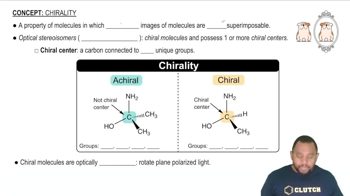
    A chiral molecule is one whose mirror image is non-superimposable on itself.
  • What is a chiral center in a molecule?

    A chiral center is a carbon atom bonded to four different or unique groups.
  • What are optical isomers also called?

    Optical isomers are also called enantiomers.
  • What property do chiral molecules have regarding plane-polarized light?

    Chiral molecules are optically active, meaning they rotate plane-polarized light.
  • What makes a molecule achiral?

    A molecule is achiral if it does not have a carbon bonded to four unique groups.
  • How can you tell if a carbon atom is a chiral center?

    If the carbon is attached to four different groups, it is a chiral center.
  • What is the relationship between enantiomers?

    Enantiomers are non-superimposable mirror images of each other.
  • Why are chiral molecules important in pharmacology?

    Chiral molecules can interact differently with biological systems, affecting drug activity.
  • What is the first method for drawing an enantiomer?

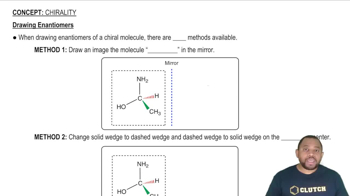
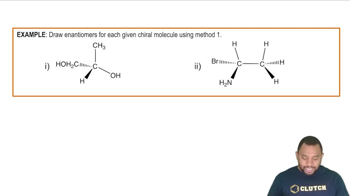
    The first method is to draw the mirror image of the molecule as it would appear in a mirror.
  • What is the second method for drawing an enantiomer called?

    The second method is called the inversion method, where you invert the dashed and wedged bonds.
  • What happens to the dashed and wedged bonds in the inversion method?

    The dashed bond becomes a wedged bond and vice versa, changing the spatial orientation.
  • What is the key feature of a molecule that makes it optically active?

    The presence of a chiral center makes a molecule optically active.
  • If a carbon is bonded to two identical groups, is it chiral or achiral?

    It is achiral because it does not have four unique groups attached.
  • What is the main difference between chiral and achiral molecules?

    Chiral molecules have non-superimposable mirror images, while achiral molecules do not.
  • What is the significance of the term 'optical isomer'?

    It refers to isomers that differ in their ability to rotate plane-polarized light due to chirality.