Constant-Volume Calorimetry definitions Flashcards
Constant-Volume Calorimetry definitions
You can tap to flip the card.
Control buttons has been changed to "navigation" mode.
1/15
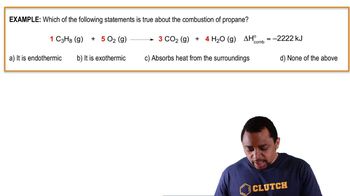
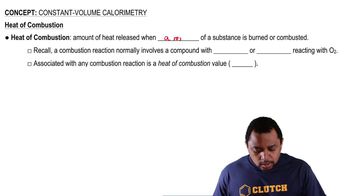
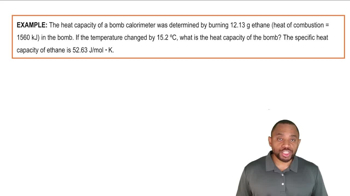
Heat of CombustionThe energy released when a mole of a substance undergoes combustion, typically involving carbon and hydrogen or oxygen.Enthalpy of CombustionThe enthalpy change when one mole of a substance is burned completely in oxygen under standard conditions.Bomb CalorimeterA device used for measuring the heat released during combustion reactions at constant volume.Constant Volume CalorimetryA method where the volume remains fixed during a reaction, ensuring no expansion occurs in the calorimeter.Exothermic ProcessA reaction that releases heat, resulting in a negative enthalpy change.Calorimeter's Heat CapacityThe amount of heat required to raise the temperature of the calorimeter by one degree Celsius.Temperature ChangeThe difference in temperature measured before and after a reaction in the calorimeter.Combustible SampleThe substance placed in the calorimeter that undergoes combustion to release heat.FusesWires in the bomb calorimeter that ignite the combustion reaction.ThermometerAn instrument used to measure the temperature change during the calorimetry process.StirrerA device used to evenly distribute heat throughout the water in the calorimeter.Standard Enthalpy of CombustionThe enthalpy change when one mole of a substance is burned in excess oxygen at standard conditions.Heat LostThe amount of heat released by the reaction, calculated as negative in exothermic processes.Heat GainedThe amount of heat absorbed by the calorimeter and water, equal to the heat lost by the reaction.MCATA formula representing the heat gained by a substance, where M is mass, C is specific heat, and T is temperature change.