Constant-Volume Calorimetry quiz #1 Flashcards

Constant-Volume Calorimetry quiz #1
Control buttons has been changed to "navigation" mode.
1/10
  • Compare the calorimeter that you built in a typical laboratory experiment to a bomb calorimeter. How are they similar and different?
    Both types of calorimeters are used to measure the heat released during chemical reactions, but a bomb calorimeter is specifically designed for combustion reactions and operates at constant volume. It consists of a sealed steel container (the 'bomb') that prevents expansion during combustion, ensuring accurate measurement of heat released. The bomb calorimeter also includes features like ignition wires, a thermometer, and a stirrer to evenly distribute heat in the surrounding water. In contrast, a simple laboratory calorimeter (such as a coffee-cup calorimeter) is usually not sealed, operates at constant pressure, and is less robust, making it unsuitable for reactions that produce gases or require high containment. The bomb calorimeter provides more precise measurements for exothermic reactions, especially combustion, due to its controlled environment and constant volume.
  • What type of chemical reaction is most commonly studied using a bomb calorimeter?
    Combustion reactions, especially those involving compounds with carbon and hydrogen or carbon, hydrogen, and oxygen, are most commonly studied using a bomb calorimeter.
  • Why is the volume inside a bomb calorimeter kept constant during a reaction?
    The volume is kept constant to ensure accurate measurement of heat released, as the sealed steel container prevents expansion during the combustion reaction.
  • What role do the ignition wires (fuses) play in a bomb calorimeter?
    The ignition wires are used to initiate the combustion reaction by igniting the combustible sample inside the calorimeter.
  • How is the heat released by the sample distributed in the bomb calorimeter?
    A stirrer is used to evenly distribute the heat released by the sample throughout the water surrounding the bomb.
  • What does a positive value of Q indicate in the context of calorimetry?
    A positive value of Q indicates that heat is gained by the calorimeter and water from the reaction.
  • How is the temperature change during a bomb calorimeter experiment measured?
    The temperature change is measured using a thermometer placed in the water surrounding the bomb.
  • What is the formula used to calculate the heat gained by the calorimeter and water in constant-volume calorimetry?
    The formula is ΔSrxn° = CΔT, where C is the heat capacity and ΔT is the change in temperature.
  • Why is the enthalpy of combustion considered negative in these experiments?
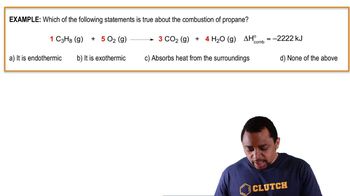
    It is negative because combustion is an exothermic process, meaning heat is released by the reaction.
  • What is the relationship between the heat lost by the reaction and the heat gained by the calorimeter in a bomb calorimeter?
    The heat lost by the reaction is equal in magnitude but opposite in sign to the heat gained by the calorimeter and water.