General Chemistry
My Course
Learn
Exam Prep
AI Tutor
Study Guides
Textbook Solutions
Flashcards
Explore
My Course
Learn
Exam Prep
AI Tutor
Study Guides
Textbook Solutions
Flashcards
Explore
Effusion quiz Flashcards
Back
Effusion quiz
You can tap to flip the card.
Which of the following is true about diffusion?
You can tap to
flip the card.
👆
Which of the following is true about diffusion?
Diffusion is the movement of gas from a region of high concentration to low concentration, regardless of the direction.
Track progress
Control buttons has been changed to "navigation" mode.
1/10
Related flashcards
Related practice
Recommended videos
Guided course
02:33
Effusion vs Diffusion
Jules
2933
views
17
rank
Guided course
00:37
Effusion Rate
Jules
2690
views
10
rank
Guided course
01:31
Effusion Rate Example
Jules
2675
views
16
rank
Terms in this set (10)
Hide definitions
Which of the following is true about diffusion?
Diffusion is the movement of gas from a region of high concentration to low concentration, regardless of the direction.
Which will have a faster diffusion rate: a lighter gas or a heavier gas?
A lighter gas will have a faster diffusion rate because it moves more quickly than a heavier gas.
Which of the following solutes would move the fastest: helium, oxygen, or carbon dioxide?
Helium would move the fastest because it has the lowest molar mass among the three gases.
Which of the following statements about diffusion is correct?
Diffusion involves gas molecules moving from an area of high concentration to an area of low concentration.
Which concentration gradient would result in a faster diffusion of oxygen: a steep gradient or a shallow gradient?
A steep concentration gradient would result in a faster diffusion of oxygen.
What is the mean free path in the context of gas behavior?
The mean free path is the average distance traveled by gas molecules between their collisions.
How does Graham's law of effusion relate to the molar mass of a gas?
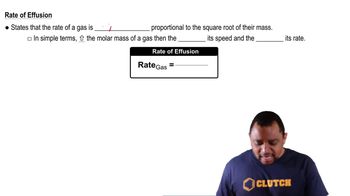
Graham's law states that the rate of effusion is inversely proportional to the square root of the gas's molar mass.
What is the primary difference between effusion and diffusion?
Effusion is the escape of gas through a tiny pinhole, while diffusion is the movement of gas from high to low concentration.
How does the molar mass of a gas affect its effusion rate?
A gas with a lower molar mass effuses more rapidly than a gas with a higher molar mass.
What happens to the speed of a gas as its molar mass increases?
As the molar mass of a gas increases, its speed decreases.