Electron Capture & Positron Emission definitions Flashcards

Electron Capture & Positron Emission definitions
Control buttons has been changed to "navigation" mode.
1/12
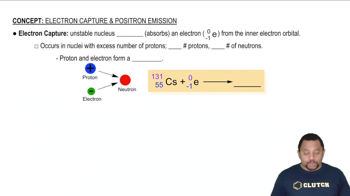
  • Electron Capture
    A process where an unstable nucleus absorbs an electron, converting a proton into a neutron, reducing proton count.
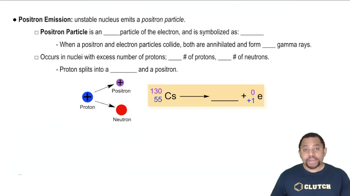
  • Positron Emission
    A process where a proton transforms into a neutron, emitting a positron, reducing the proton count.
  • Proton
    A subatomic particle found in the nucleus with a positive charge, its number defines the element.
  • Neutron
    A subatomic particle in the nucleus with no charge, contributing to the atomic mass.
  • Positron
    An antiparticle of the electron with a positive charge and no mass number, emitted during positron emission.
  • Antiparticle
    A particle with the same mass as another particle but opposite charge, such as a positron to an electron.
  • Gamma Rays
    High-energy electromagnetic radiation emitted during particle annihilation, such as electron-positron collisions.
  • Mass Number
    The total number of protons and neutrons in an atomic nucleus, remains constant in nuclear reactions.
  • Atomic Number
    The number of protons in an atom's nucleus, determining the element's identity.
  • Xenon
    A noble gas element formed from cesium through electron capture or positron emission.
  • Cesium
    A chemical element that undergoes electron capture or positron emission to form xenon.
  • Nucleus
    The central part of an atom containing protons and neutrons, where nuclear reactions occur.