Electron Configurations of Transition Metals: Exceptions definitions Flashcards
Electron Configurations of Transition Metals: Exceptions definitions
You can tap to flip the card.
Control buttons has been changed to "navigation" mode.
1/15
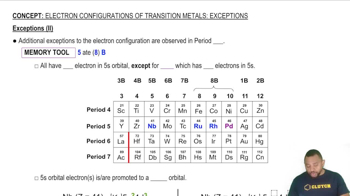
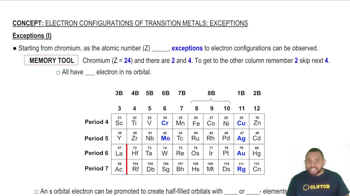
Transition MetalsElements in the d-block of the periodic table, known for having variable oxidation states.Electron ConfigurationThe distribution of electrons in an atom's orbitals, crucial for understanding chemical properties.ChromiumA transition metal with atomic number 24, known for its electron configuration exception.Atomic NumberThe number of protons in an atom's nucleus, determining its position in the periodic table.S OrbitalA spherical electron orbital, capable of holding up to two electrons.D OrbitalA set of five orbitals in the d-block, each capable of holding two electrons.Half-filled OrbitalsA stable electron configuration where each orbital in a subshell has one electron.PalladiumA transition metal with a unique electron configuration, lacking electrons in its 5s orbital.NiobiumA transition metal with an electron configuration exception, promoting an electron to the d orbital.ArgonA noble gas used as a reference point in electron configurations for transition metals.KryptonA noble gas used as a reference in electron configurations, preceding transition metals like Niobium.Period 5The fifth row of the periodic table, containing elements with notable electron configuration exceptions.Group 5BA group in the periodic table containing transition metals with electron configuration exceptions.Group 8BA group in the periodic table with transition metals exhibiting unique electron configurations.Electron PromotionThe process of moving an electron from a lower energy orbital to a higher one, often seen in exceptions.