Emission Spectrum quiz #1 Flashcards

Emission Spectrum quiz #1
Control buttons has been changed to "navigation" mode.
1/30
  • Which of the following best describes an atomic emission spectrum?
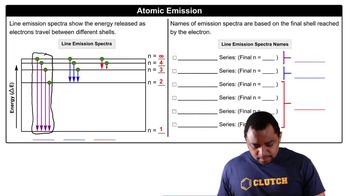
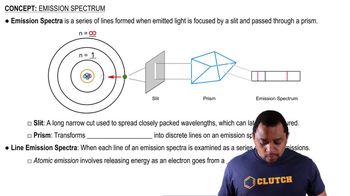
    An atomic emission spectrum consists of distinct lines of color produced when electrons in an atom transition from higher to lower energy levels, emitting light at specific wavelengths.
  • What happens when an electron falls from a higher energy level to a lower energy level in an atom?
    The electron releases energy in the form of light, producing a photon with a wavelength corresponding to the energy difference between the levels.
  • Which electron transition in the hydrogen atom produces light of the highest frequency?
    The transition from the highest energy level (e.g., n = ∞) to the lowest energy level (n = 1) produces light of the highest frequency, which is in the ultraviolet region.
  • How many possible emissions can occur for an electron in the n = 4 level as it returns to the ground state in a hydrogen atom?
    An electron in the n = 4 level can make 6 possible emissions as it transitions to lower energy levels (n = 3, 2, or 1).
  • Which type of spectrum consists of lines representing distinct frequencies?
    A line spectrum consists of lines representing distinct frequencies, each corresponding to a specific electron transition.
  • Excited hydrogen atoms emit radiation in which regions of the electromagnetic spectrum?
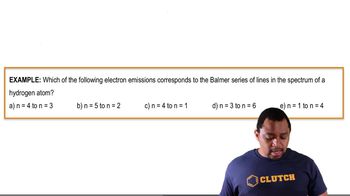
    Excited hydrogen atoms emit radiation in the ultraviolet (Lyman series), visible (Balmer series), and infrared (Paschen and higher series) regions.
  • Which transition in a hydrogen atom would emit a photon of the greatest frequency?
    The transition from n = ∞ (or a very high level) to n = 1 emits a photon of the greatest frequency (ultraviolet light).
  • How does an atom emit light?
    An atom emits light when an electron transitions from a higher energy level to a lower one, releasing energy as a photon.
  • Which electronic transition corresponds to the shortest wavelength emission?
    The transition from the highest energy level to the lowest (e.g., n = ∞ to n = 1) corresponds to the shortest wavelength emission.
  • Which of the following emits light characterized by a line spectrum?
    Atoms emit light characterized by a line spectrum when their electrons transition between discrete energy levels.
  • What kind of spectrum does a neon sign produce?
    A neon sign produces a line emission spectrum, with distinct colored lines corresponding to electron transitions in neon atoms.
  • What is emitted when an electron relaxes from an excited state to the ground state?
    A photon of light is emitted when an electron relaxes from an excited state to the ground state.
  • Why do only certain colors appear in the emission spectrum for a given element?
    Only certain colors appear because electrons can only transition between specific energy levels, emitting photons of specific energies (wavelengths).
  • What kind of spectra were analyzed to determine the atomic numbers of elements?
    Line emission spectra were analyzed to determine the atomic numbers of elements.
  • What explains the discrete lines in atomic emission spectra?
    The discrete lines are explained by electrons transitioning between specific energy levels, each transition releasing energy at a particular wavelength.
  • Which scientific phenomenon helps scientists determine the chemical composition of stars?
    Analysis of atomic emission and absorption spectra helps scientists determine the chemical composition of stars.
  • Why do different types of atoms (elements) give off or absorb different spectral lines?
    Different elements have unique sets of energy levels, so their electrons emit or absorb photons at different wavelengths, producing unique spectral lines.
  • How do atoms emit light?
    Atoms emit light when electrons drop from higher to lower energy levels, releasing energy as photons.
  • Based on the hydrogen emission spectrum, what regions of the electromagnetic spectrum are observed?
    The hydrogen emission spectrum includes ultraviolet (Lyman series), visible (Balmer series), and infrared (Paschen and higher series) regions.
  • What causes the emission spectrum of an element?
    The emission spectrum of an element is caused by electrons transitioning between energy levels and emitting photons of specific energies.
  • What is observed when a noble gas is heated and the emitted light is passed through a prism?
    Distinct colored lines are observed, forming a line emission spectrum characteristic of the noble gas.
  • What wavelengths appear in the system's emission spectrum?
    Only wavelengths corresponding to allowed electron transitions between energy levels appear in the system's emission spectrum.
  • What wavelengths appear in the atom's emission spectrum?
    The atom's emission spectrum contains wavelengths corresponding to the energy differences between its allowed electron energy levels.
  • Given the emission spectrum of iodine, which spectrum would be its absorption spectrum?
    The absorption spectrum would show dark lines at the same wavelengths as the bright lines in the emission spectrum, where light is absorbed by iodine.
  • In which case will a person see a rainbow of color interrupted by a few dark absorption lines?
    When white light passes through a cool gas and then through a prism, a continuous spectrum with dark absorption lines is observed.
  • An atom’s emission of light with a specific amount of energy confirms that:
    Atoms have discrete energy levels, and electrons transition between them by absorbing or emitting specific amounts of energy.
  • Among the following hydrogen atom transitions, which would emit a photon of light with the greatest energy?
    The transition from n = ∞ (or highest possible level) to n = 1 emits a photon with the greatest energy.
  • Consider the Lyman series of electron transitions in hydrogen. What region of the electromagnetic spectrum does it belong to?
    The Lyman series belongs to the ultraviolet region of the electromagnetic spectrum.
  • How can you predict the qualitative features of a line spectrum?
    By knowing the allowed energy levels and possible electron transitions, you can predict the number and position of lines in the spectrum.
  • Consider the Lyman series for atomic transitions in hydrogen. What is the final energy level for these transitions?
    The final energy level for the Lyman series transitions in hydrogen is n = 1.