Pearson+ LogoPearson+ Logo

Entropy quiz #1 Flashcards

Back
Entropy quiz #1
Control buttons has been changed to "navigation" mode.
1/12
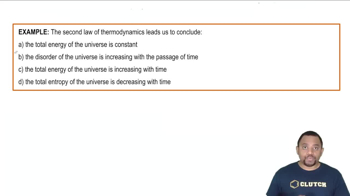
  • What is the natural tendency of entropy over time according to the second law of thermodynamics?

    Entropy naturally increases over time; the entropy of the universe always increases in spontaneous processes.
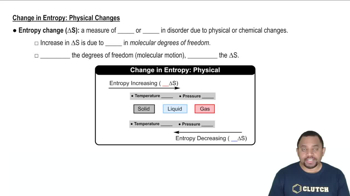
  • Which phase of matter has the highest entropy?

    The gas phase has the highest entropy.
  • Which term best describes entropy in a chemical system?

    Entropy is best described as disorder, randomness, or chaos in a system.
  • Which state of matter has the lowest entropy?

    The solid state has the lowest entropy.
  • What word or phrase best describes entropy?

    Entropy is best described as a measure of disorder or randomness.
  • What does a negative change in entropy (ΔS < 0) indicate about a system?

    A negative change in entropy indicates that the system has become more ordered or less random.
  • Among solids, liquids, and gases, which state of matter has the highest entropy?

    Gases have the highest entropy among the three states of matter.
  • What state of matter has the highest entropy and why?

    The gaseous state has the highest entropy because its molecules are most spread out and have the most freedom of movement.
  • What does the entropy of a reaction describe?

    The entropy of a reaction describes the change in disorder or randomness in the system as the reaction proceeds.
  • What type of chemical reaction would result in decreased entropy?

    A reaction where the number of moles of products is less than the number of moles of reactants results in decreased entropy.
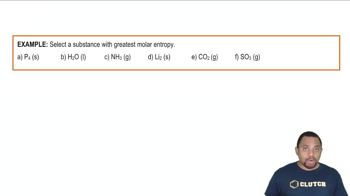
  • How can you compare the entropy of different substances in the same phase?

    For substances in the same phase, compare their molecular complexity (number of atoms) and mass; greater complexity and mass mean higher entropy.
  • Which state of matter has the most entropy and why?

    The gaseous state has the most entropy because its particles have the greatest freedom of movement and are most disordered.