Back

Galvanic Cell quiz

Control buttons has been changed to "navigation" mode.
1/15
  • What is the main function of a galvanic cell?

    A galvanic cell generates electricity through spontaneous redox reactions by converting chemical energy into electrical energy.
  • What is another name for a galvanic cell?

    A galvanic cell is also called a voltaic cell.
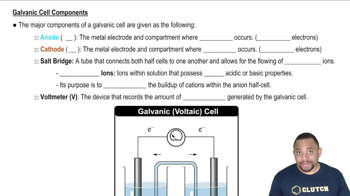
  • Where does oxidation occur in a galvanic cell?

    Oxidation occurs at the anode, which is the negatively charged electrode.
  • Where does reduction occur in a galvanic cell?

    Reduction occurs at the cathode, which is the positively charged electrode.
  • What is the charge of the anode in a galvanic cell?

    The anode is negatively charged.
  • What is the charge of the cathode in a galvanic cell?

    The cathode is positively charged.
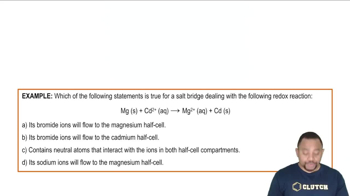
  • What is the purpose of the salt bridge in a galvanic cell?

    The salt bridge maintains charge balance by allowing neutral ions to flow between the two half-cells.
  • What happens to the mass of the anode over time in a galvanic cell?

    The anode loses mass over time because it dissolves as it loses electrons.
  • What happens to the mass of the cathode over time in a galvanic cell?

    The cathode gains mass over time as it attracts cations and plates out.
  • What does a voltmeter measure in a galvanic cell?

    A voltmeter measures the voltage, or the amount of electricity generated by the cell.
  • What is the direction of electron flow in a galvanic cell?

    Electrons flow from the anode to the cathode through a conductive wire.
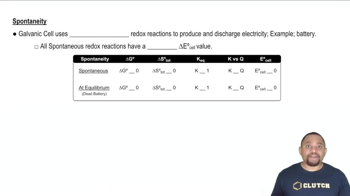
  • What is the standard cell potential (E°cell) for a spontaneous reaction in a galvanic cell?

    The standard cell potential (E°cell) is positive for spontaneous reactions.
  • What happens to a galvanic cell when it reaches equilibrium?

    When a galvanic cell reaches equilibrium, it has used up all its electricity and its cell potential becomes zero.
  • What is the overall redox reaction for a zinc-copper galvanic cell?

    Zinc is oxidized to Zn²⁺ and copper(II) ions are reduced to copper solid, resulting in Zn(s) + Cu²⁺(aq) → Zn²⁺(aq) + Cu(s).
  • What are the conditions for spontaneity in a galvanic cell regarding Gibbs free energy and equilibrium constant?

    For spontaneity, ΔG° must be less than 0 and the equilibrium constant (K) must be greater than 1.