Back

Gas Stoichiometry quiz

Control buttons has been changed to "navigation" mode.
1/15
  • What does stoichiometry study in chemistry?

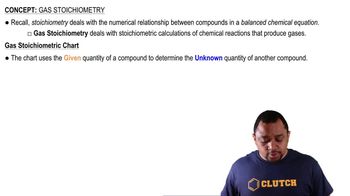
    Stoichiometry studies the quantitative relationships between compounds in a balanced chemical equation.
  • What is gas stoichiometry specifically concerned with?

    Gas stoichiometry deals with stoichiometric calculations for reactions that produce gases.
  • Which equation is essential for gas stoichiometry calculations?

    The ideal gas law, PV = nRT, is essential for gas stoichiometry calculations.
  • What does 'n' represent in the ideal gas law PV = nRT?

    'n' represents the number of moles of gas.
  • How can you determine the moles of a gas using the ideal gas law?

    You can determine moles by rearranging the equation: n = PV/RT.
  • What is the purpose of a stoichiometric chart in gas stoichiometry?

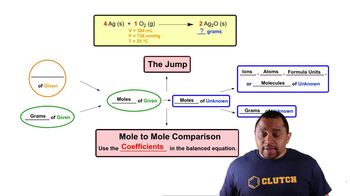
    A stoichiometric chart helps convert a known quantity of a compound to an unknown quantity in a balanced equation.
  • What is the 'jump' in stoichiometry?

    The 'jump' refers to converting from moles of a given substance to moles of an unknown substance using the balanced equation.
  • How do you perform the 'jump' in stoichiometry?

    You use the coefficients from the balanced chemical equation to compare moles of given and unknown substances.
  • After finding moles of the unknown, what can you convert them into?

    You can convert moles of the unknown into ions, atoms, formula units, molecules, or grams.
  • If given pressure, volume, and temperature of a gas, what can you calculate first?

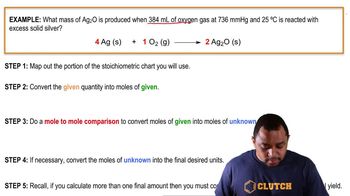
    You can first calculate the moles of the gas using the ideal gas law.
  • What information do you need to use the ideal gas law?

    You need the pressure, volume, temperature, and the gas constant (R).
  • Why is it important to use a balanced chemical equation in stoichiometry?

    A balanced equation provides the correct mole ratios for converting between substances.
  • What is the relationship between grams and moles in stoichiometry?

    Grams can be converted to moles using the molar mass of the substance.
  • What is the final step in a gas stoichiometry problem if you are asked for mass?

    The final step is to convert moles of the unknown gas or compound to grams using its molar mass.
  • Why might you need to review the stoichiometric chart before solving gas stoichiometry problems?

    Reviewing the chart helps you understand the steps and conversions needed for accurate calculations.