Back

Half-Life quiz

Control buttons has been changed to "navigation" mode.
1/15
  • What is the definition of half-life in chemistry?

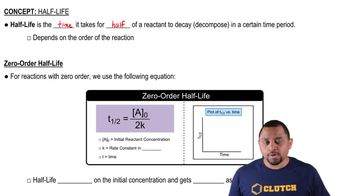
    Half-life is the time it takes for half of a reactant to decay or decompose.
  • How does the half-life of a zero-order reaction depend on the initial concentration?

    For zero-order reactions, half-life is directly proportional to the initial concentration of the reactant.
  • What is the equation for the half-life of a zero-order reaction?

    The equation is t₁/₂ = [A]₀ / (2k), where [A]₀ is the initial concentration and k is the rate constant.
  • What happens to the half-life of a zero-order reaction as the concentration decreases?

    The half-life gets shorter as the concentration decreases.
  • How is half-life represented graphically for a zero-order reaction?

    It is shown as a decreasing line (negative slope) with half-life on the y-axis and time on the x-axis.
  • What is the equation for the half-life of a first-order reaction?

    The equation is t₁/₂ = ln(2) / k, where k is the rate constant.
  • Does the half-life of a first-order reaction depend on the initial concentration?

    No, the half-life of a first-order reaction is independent of the initial concentration.
  • What is the value of ln(2) used in the first-order half-life equation?

    ln(2) is approximately 0.693.
  • How does the half-life of a first-order reaction change over time?

    It remains constant throughout the reaction.
  • What type of reactions commonly follow first-order kinetics?

    Radioactive decay processes commonly follow first-order kinetics.
  • What is the equation for the half-life of a second-order reaction?

    The equation is t₁/₂ = 1 / (k[A]₀), where [A]₀ is the initial concentration and k is the rate constant.
  • How does the half-life of a second-order reaction depend on the initial concentration?

    The half-life increases as the initial concentration decreases.
  • How is half-life represented graphically for a first-order reaction?

    It is shown as a flat line (constant) with half-life on the y-axis and time on the x-axis.
  • Why are first-order processes preferred for radioactive decay studies?

    Because their half-life remains constant, making them more predictable and consistent.
  • What are the units of the rate constant k for zero, first, and second-order reactions?

    Zero-order: M·time⁻¹; First-order: time⁻¹; Second-order: M⁻¹·time⁻¹.