Back

Halogenation Reactions quiz

Control buttons has been changed to "navigation" mode.
1/15
  • What is added to an alkene during a halogenation reaction?

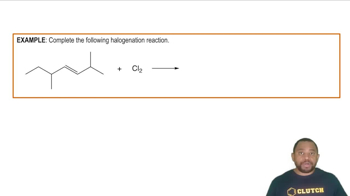
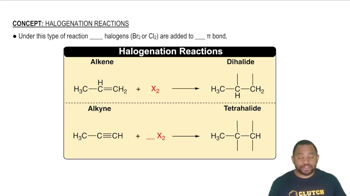
    Two halogen atoms, such as Br2 or Cl2, are added to the alkene.
  • What is the product called when two halogens are added to an alkene?

    The product is called a dihalide.
  • How many pi bonds does an alkene have?

    An alkene has one pi bond.
  • How many moles of halogen reagent are needed per pi bond in halogenation?

    One mole of halogen reagent is needed for each pi bond.
  • What is the product called when four halogens are added to an alkyne?

    The product is called a tetrahalide.
  • How many pi bonds does an alkyne have?

    An alkyne has two pi bonds.
  • How many moles of halogen reagent are required to fully halogenate an alkyne?

    Two moles of halogen reagent are required.
  • What happens to each carbon in the double bond during halogenation of an alkene?

    Each carbon in the double bond gains one halogen atom.
  • What is the general formula for the halogen reagent used in halogenation reactions?

    The general formula is X2, where X is a halogen like Br or Cl.
  • What type of compounds are formed by halogenation of unsaturated hydrocarbons?

    Halogenated compounds, such as dihalides or tetrahalides, are formed.
  • Why is halogenation important in organic synthesis?

    It transforms unsaturated hydrocarbons into more reactive halogenated compounds.
  • What is the result of adding one mole of Br2 to an alkyne?

    Two bromine atoms are added, forming a dihalide intermediate.
  • What is the result of adding two moles of Cl2 to an alkyne?

    Four chlorine atoms are added, resulting in a tetrahalide.
  • What is the relationship between the number of pi bonds and the number of halogen atoms added?

    Two halogen atoms are added for each pi bond present.
  • What is the main difference in halogenation between alkenes and alkynes?

    Alkenes form dihalides with one mole of halogen, while alkynes form tetrahalides with two moles.