General Chemistry
My Course
Learn
Exam Prep
AI Tutor
Study Guides
Textbook Solutions
Flashcards
Explore
My Course
Learn
Exam Prep
AI Tutor
Study Guides
Textbook Solutions
Flashcards
Explore
Back
Heat Capacity quiz
You can tap to flip the card.
Define:
What explains why water has a high specific heat?
You can tap to
flip the card.
👆
What explains why water has a high specific heat?
Water's molecular structure, specifically hydrogen bonding, helps explain why water has a high specific heat.
Track progress
Control buttons has been changed to "navigation" mode.
1/10
Related flashcards
Related practice
Recommended videos
Guided course
00:31
Heat Capacity
Jules
8733
views
62
rank
2
comments
Guided course
00:33
Heat Capacity Example 1
Jules
8097
views
58
rank
Guided course
02:19
Heat Capacity
Jules
8323
views
56
rank
1
comments
Terms in this set (10)
Hide definitions
What explains why water has a high specific heat?
Water's molecular structure, specifically hydrogen bonding, helps explain why water has a high specific heat.
What is the amount of energy required to raise one gram of water by 1 degree Celsius?
The amount of energy required to raise one gram of water by 1 degree Celsius is 4.18 joules.
Which best explains why water has a high specific heat?
Water has a high specific heat due to the hydrogen bonds between water molecules, which require more energy to break.
What is the amount of energy required to raise one gram of water by 1∘C?
The amount of energy required to raise one gram of water by 1∘C is 4.18 joules.
What is the amount of heat required to raise the temperature of water referred to as?
The amount of heat required to raise the temperature of water is referred to as specific heat capacity.
What is the formula for calculating heat absorbed or released using specific heat capacity?
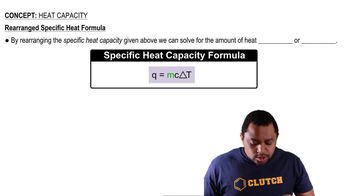
The formula is Q = mcΔT, where Q is heat, m is mass, c is specific heat capacity, and ΔT is the temperature change.
What does the symbol 'c' represent in the context of heat capacity?
In the context of heat capacity, 'c' represents specific heat capacity.
How does molar heat capacity differ from specific heat capacity?
Molar heat capacity refers to the heat required to change the temperature of one mole of a substance, while specific heat capacity refers to one gram.
What units are used for specific heat capacity?
Specific heat capacity is measured in joules per gram per degree Celsius (J/g°C) or joules per gram per Kelvin (J/gK).
What is the relationship between heat and temperature change?
Heat is directly proportional to temperature change; more heat results in a greater temperature increase.