Heating and Cooling Curves definitions Flashcards

Heating and Cooling Curves definitions
Control buttons has been changed to "navigation" mode.
1/15
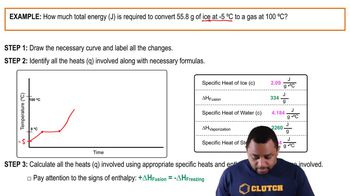
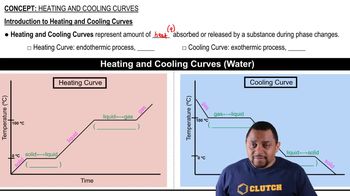
  • Heating Curve
    Graph showing heat absorption by a substance during phase changes, indicating endothermic processes.
  • Cooling Curve
    Graph depicting heat release by a substance during phase changes, indicating exothermic processes.
  • Endothermic Process
    A process where a substance absorbs heat, resulting in a positive heat variable (Q).
  • Exothermic Process
    A process where a substance releases heat, resulting in a negative heat variable (Q).
  • Phase Change
    Transition of a substance between solid, liquid, and gas phases, marked by constant temperature.
  • Melting
    Transition from solid to liquid, occurring at a constant temperature, also known as fusion.
  • Vaporization
    Transition from liquid to gas, occurring at a constant temperature, requiring energy absorption.
  • Condensation
    Transition from gas to liquid, occurring at a constant temperature, involving energy release.
  • Freezing
    Transition from liquid to solid, occurring at a constant temperature, involving energy release.
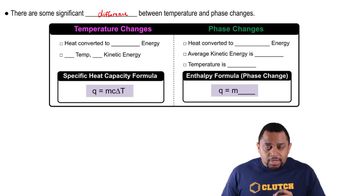
  • Specific Heat Capacity
    Amount of heat required to change the temperature of a unit mass of a substance by one degree.
  • Kinetic Energy
    Energy of motion, increasing with temperature during temperature changes.
  • Potential Energy
    Energy stored during phase changes, maintaining constant temperature and kinetic energy.
  • Enthalpy
    Measure of heat content used in phase change calculations, represented by ΔH.
  • Plateau
    Flat section on a heating or cooling curve indicating a phase change with constant temperature.
  • Delta T (ΔT)
    Change in temperature, calculated as final temperature minus initial temperature.