Heating and Cooling Curves quiz #1 Flashcards

Heating and Cooling Curves quiz #1
Control buttons has been changed to "navigation" mode.
1/10
  • Which statement accurately describes a cooling curve?
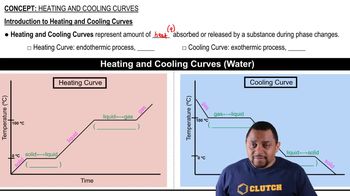
    A cooling curve shows how a substance releases heat (exothermic process, Q negative) as it transitions from gas to liquid (condensation) and then to solid (freezing), with temperature plateaus during phase changes.
  • Which of the following correctly describes a heating-cooling curve?
    A heating-cooling curve illustrates how a substance absorbs heat (endothermic, Q positive) during heating and releases heat (exothermic, Q negative) during cooling, with temperature increases or decreases between phase changes and plateaus at phase transitions.
  • Which arrows on a heating curve represent phase transitions in which heat energy is gained?
    Arrows indicating transitions from solid to liquid (melting/fusion) and from liquid to gas (vaporization) represent phase changes where heat energy is gained (endothermic processes).
  • Which of the following correctly describes a heating or cooling curve?
    Heating or cooling curves show temperature changes and phase transitions of a substance as it absorbs or releases heat, with temperature plateaus during phase changes and sloped segments during temperature changes.
  • At what temperature does water undergo the phase change from solid to liquid on a heating curve?
    Water undergoes the phase change from solid to liquid at 0 degrees Celsius, which is the melting or fusion point.
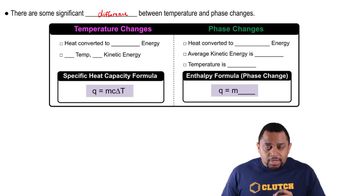
  • What type of energy does heat convert into during a phase change when temperature remains constant?
    During a phase change, heat is converted into potential energy, keeping the average kinetic energy and temperature constant.
  • Which formula is used to calculate the heat absorbed or released during a temperature change?
    The formula used is Q = mcΔT, where Q is heat, m is mass, c is specific heat capacity, and ΔT is the change in temperature.
  • What happens to the temperature of a substance during a phase change on a heating or cooling curve?
    The temperature remains constant during a phase change, resulting in a plateau on the curve.
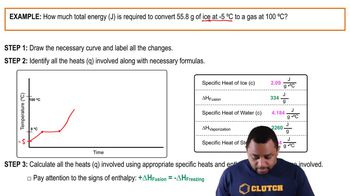
  • How do you calculate the total energy involved in a heating or cooling curve?
    You sum the heat calculated for each segment of the curve, using the appropriate formula for temperature or phase changes.
  • What phase change occurs at 100 degrees Celsius for water during cooling?
    At 100 degrees Celsius, water undergoes condensation, transitioning from gas to liquid.