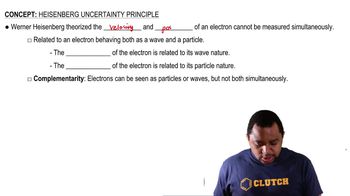
Can an electron be found in an exact spot within an atom according to the Heisenberg uncertainty principle?
No, the Heisenberg uncertainty principle states that it is impossible to know both the exact position and velocity of an electron simultaneously. Therefore, an electron cannot be found in an exact spot within an atom.
Which of the following is a consequence of the Heisenberg uncertainty principle: precise measurement of both position and velocity of an electron is impossible?
A consequence of the Heisenberg uncertainty principle is that the more precisely we know an electron's position, the less precisely we can know its velocity, and vice versa. Thus, it is impossible to measure both properties exactly at the same time.
What is the relationship called that describes electrons behaving as both waves and particles?
This relationship is called complementarity, meaning electrons can be seen as either particles or waves, but not both at the same time.
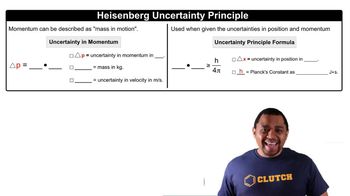
How is the uncertainty in momentum (ΔP) of an electron expressed in terms of units?
The uncertainty in momentum is expressed in units of kilograms times meters per second (kg·m/s).
What does the variable ΔX represent in the Heisenberg uncertainty principle formula?
ΔX represents the uncertainty in the position of an electron, measured in meters.
What is the value and unit of Planck's constant used in the uncertainty principle formula?
Planck's constant is 6.626 x 10^-34 joule seconds (J·s).
How can the uncertainty in momentum (ΔP) be further expanded in terms of mass and velocity?
ΔP can be expanded as mass (m) times uncertainty in velocity (Δv), or ΔP = m·Δv.
What does the uncertainty principle formula mathematically state about ΔX and ΔP?
The formula states that ΔX times ΔP must be greater than or equal to h divided by 4π (ΔX·ΔP ≥ h/4π).
Why is it impossible to know both the velocity and position of an electron at the same time?
It is impossible because measuring one property precisely increases the uncertainty in the other, due to the electron's wave-particle duality.
What is the equivalent unit for Planck's constant besides joule seconds?
Planck's constant can also be expressed as kilograms times meters squared per second (kg·m²/s).