Henderson-Hasselbalch Equation definitions Flashcards

Henderson-Hasselbalch Equation definitions
Control buttons has been changed to "navigation" mode.
1/10
  • Henderson-Hasselbalch Equation
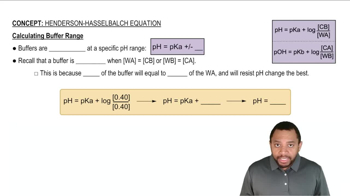
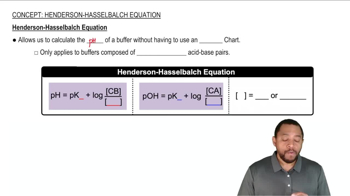
    A formula used to calculate the pH of a buffer solution using pKa or pKb and the ratio of conjugate base to weak acid or conjugate acid to weak base.
  • Buffer
    A solution that resists changes in pH when small amounts of acid or base are added, typically composed of a weak acid and its conjugate base or a weak base and its conjugate acid.
  • Conjugate Acid-Base Pair
    A pair of compounds that transform into each other by gain or loss of a proton, crucial in buffer solutions.
  • pKa
    The negative logarithm of the acid dissociation constant, indicating the strength of an acid in solution.
  • pKb
    The negative logarithm of the base dissociation constant, indicating the strength of a base in solution.
  • Molarity
    A measure of concentration, defined as the number of moles of solute per liter of solution.
  • Moles
    A unit of measurement for amount of substance, representing Avogadro's number of particles.
  • pH Range
    The range within which a buffer effectively resists changes in pH, typically pKa ± 1.
  • Concentration
    The abundance of a constituent divided by the total volume of a mixture, often expressed in molarity.
  • Logarithm
    A mathematical operation that is the inverse of exponentiation, used in the Henderson-Hasselbalch equation.