Hydrogen Isotopes definitions Flashcards

Hydrogen Isotopes definitions
Control buttons has been changed to "navigation" mode.
1/15
  • Protium
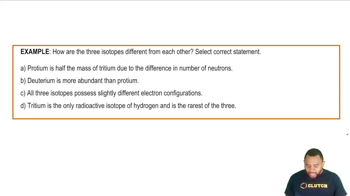
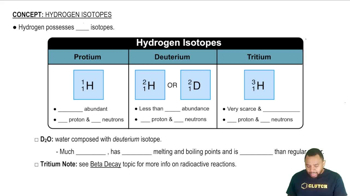
    The most abundant hydrogen isotope with one proton and no neutrons, having an atomic and mass number of 1.
  • Deuterium
    A hydrogen isotope with one proton and one neutron, less than 1% abundance, and represented as ²H or ²D.
  • Tritium
    A rare, radioactive hydrogen isotope with one proton and two neutrons, produced by neutron bombardment of lithium-6.
  • Atomic Number
    The number of protons in an atom's nucleus, determining the element's identity.
  • Mass Number
    The total number of protons and neutrons in an atom's nucleus.
  • Neutron
    A subatomic particle found in the nucleus of an atom, with no electric charge.
  • Neutron Bombardment
    A process where neutrons are directed at a target nucleus, often used to create isotopes like tritium.
  • Electron Emission
    A process where an electron is emitted from a nucleus, associated with beta decay in radioactive isotopes.
  • Beta Decay
    A radioactive decay process where a beta particle (electron or positron) is emitted from an atomic nucleus.
  • Deuterium Oxide
    Also known as heavy water, it is water where hydrogen is replaced by deuterium, resulting in higher density and boiling point.
  • Density
    A measure of mass per unit volume, indicating how compact a substance is.
  • Melting Point
    The temperature at which a solid becomes a liquid.
  • Boiling Point
    The temperature at which a liquid turns into vapor.
  • Radioactivity
    The emission of particles or electromagnetic waves due to the decay of atomic nuclei.
  • Lithium-6
    An isotope of lithium used in the production of tritium through neutron bombardment.