Back

Hydrogenation Reactions quiz

Control buttons has been changed to "navigation" mode.
1/15
  • What is the main purpose of a hydrogenation reaction?

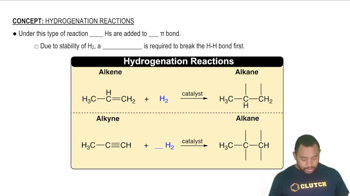
    The main purpose is to add hydrogen atoms to unsaturated hydrocarbons, converting them into saturated alkanes.
  • What type of bond is broken during a hydrogenation reaction?

    A π (pi) bond in the unsaturated hydrocarbon is broken during hydrogenation.
  • Why is a catalyst required in hydrogenation reactions?

    A catalyst is needed to break the stable hydrogen-hydrogen bond in H2 so hydrogen atoms can be added to the hydrocarbon.
  • What is typically used as a catalyst in hydrogenation reactions?

    A metal catalyst is typically used, such as platinum, palladium, or nickel.
  • How many moles of hydrogen are needed to hydrogenate one π bond?

    One mole of hydrogen (H2) is needed for each π bond present.
  • What is the product of hydrogenating an alkene?

    The product is an alkane, which contains only single bonds between carbon and hydrogen atoms.
  • How many π bonds does an alkene have?

    An alkene has one π bond.
  • How many moles of H2 are required to fully hydrogenate an alkyne?

    Two moles of H2 are required because an alkyne has two π bonds.
  • What happens to the carbon atoms involved in the double or triple bond during hydrogenation?

    Each carbon atom receives a hydrogen atom, converting the double or triple bond into single bonds.
  • What is the end product of hydrogenating an alkyne?

    The end product is an alkane.
  • What is the relationship between the number of π bonds and the amount of hydrogen needed?

    For each π bond, one mole of hydrogen is needed.
  • What is the significance of hydrogenation in organic chemistry?

    Hydrogenation is essential for modifying the saturation level of hydrocarbon chains.
  • What type of hydrocarbons undergo hydrogenation reactions?

    Unsaturated hydrocarbons such as alkenes and alkynes undergo hydrogenation.
  • What is the structural change in the hydrocarbon after hydrogenation?

    The hydrocarbon changes from having double or triple bonds to only single bonds.
  • How many hydrogen atoms are added to an alkyne during hydrogenation?

    Four hydrogen atoms are added to an alkyne, two for each π bond.