Back

Hydrohalogenation Reactions quiz

Control buttons has been changed to "navigation" mode.
1/15
  • What is hydrohalogenation?

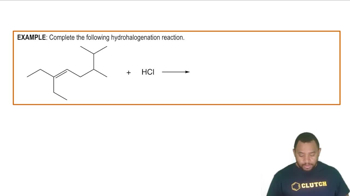
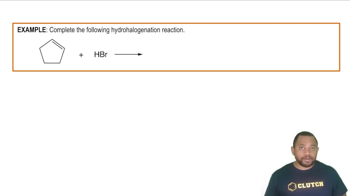
    Hydrohalogenation is a reaction where hydrogen and a halogen are added across a pi bond of an alkene or alkyne to form an alkyl halide.
  • Which elements are typically used as the halogen in hydrohalogenation?

    Bromine and chlorine are the halogens most commonly used in hydrohalogenation reactions.
  • What is the product of a hydrohalogenation reaction starting from an alkene?

    The product is an alkyl halide.
  • How does hydrohalogenation proceed with a symmetrical alkene?

    The hydrogen and halogen can add to either carbon of the double bond with no preference.
  • What rule is used to predict the outcome of hydrohalogenation with unsymmetrical alkenes?

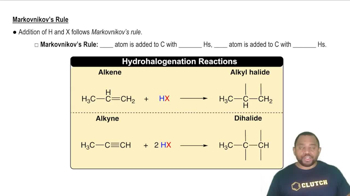
    Markovnikov's rule is used to predict the outcome.
  • According to Markovnikov's rule, where does the hydrogen atom add in an unsymmetrical alkene?

    The hydrogen atom adds to the double-bonded carbon with more hydrogens already attached.
  • Where does the halogen atom add in an unsymmetrical alkene during hydrohalogenation?

    The halogen atom adds to the double-bonded carbon with fewer hydrogens.
  • What is the general reactant and reagent in a hydrohalogenation reaction?

    The reactant is an alkene or alkyne, and the reagent is HX, where X is a halogen.
  • How many moles of HX are required to fully react with an alkyne in hydrohalogenation?

    Two moles of HX are required for a complete reaction with an alkyne.
  • What is the product when an alkyne undergoes hydrohalogenation with two moles of HX?

    The product is a dihalide, with both halogens adding to the same carbon.
  • Why is Markovnikov's rule important in hydrohalogenation?

    It helps predict which carbon will receive the hydrogen and which will receive the halogen in unsymmetrical alkenes or alkynes.
  • What type of bond is broken during hydrohalogenation?

    A pi bond in the alkene or alkyne is broken.
  • What is the difference in product formation between symmetrical and unsymmetrical alkenes in hydrohalogenation?

    Symmetrical alkenes give one product, while unsymmetrical alkenes can give regioisomers, but Markovnikov's rule predicts the major product.
  • What is the final functional group formed after hydrohalogenation of an alkene?

    An alkyl halide functional group is formed.
  • If both double-bonded carbons have the same number of hydrogens, how does hydrohalogenation proceed?

    The hydrogen and halogen can add to either carbon without preference, resulting in the same product.