Intensive vs. Extensive Properties quiz #1 Flashcards

Intensive vs. Extensive Properties quiz #1
Control buttons has been changed to "navigation" mode.
1/30
  • Which of the following is an intensive property of a substance: density, volume, length, or mass?
    Density is an intensive property; volume, length, and mass are extensive properties.
  • Which of these is an example of investigating an intensive property?
    Measuring the density of a substance is an example of investigating an intensive property.
  • Which term refers to a property that depends only on the amount of a substance?
    Extensive property refers to a property that depends on the amount of a substance.
  • Which statement describes an intensive property of matter?
    An intensive property does not depend on the amount of matter present and is inherent to the substance.
  • Which of these is an extensive property of a substance?
    Mass is an extensive property of a substance.
  • Which of the following is an extensive physical property of matter?
    Volume is an extensive physical property of matter.
  • Which is an intensive property of a substance?
    Color is an intensive property of a substance.
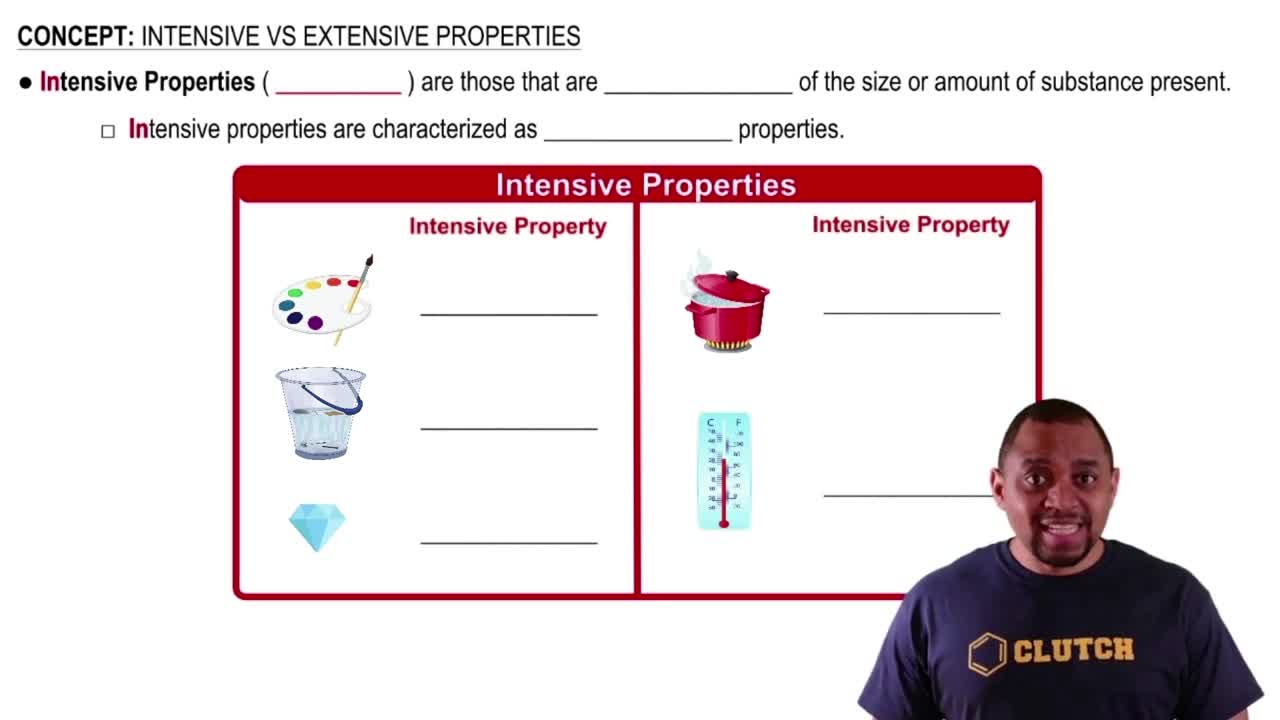
  • What is the difference between intensive and extensive properties?
    Intensive properties do not depend on the amount of substance, while extensive properties do.
  • Which of the following is an intensive property of a sample of neon gas?
    Density is an intensive property of a sample of neon gas.
  • Is melting point an intensive or extensive physical property?
    Melting point is an intensive physical property.
  • Which of the following is an example of an intensive property of a bar of gold?
    Hardness is an intensive property of a bar of gold.
  • Which of the following is an intensive physical property of matter?
    Boiling point is an intensive physical property of matter.
  • Why are intensive properties useful for identifying a substance?
    Intensive properties are useful for identification because they are unique to a substance and do not change with amount.
  • Which of the following is an example of an extensive property?
    Length is an example of an extensive property.
  • Which of the following is an intensive property?
    Temperature is an intensive property.
  • Which of the following is an extensive property of liquid benzene?
    Volume is an extensive property of liquid benzene.
  • Which of the following are intensive properties?
    Color and density are intensive properties.
  • What is an extensive property that can be calculated?
    Mass is an extensive property that can be calculated.
  • Which property of matter is an extensive property?
    Energy is an extensive property of matter.
  • Which of the following is an intensive physical property?
    Hardness is an intensive physical property.
  • Which property depends on the amount of a substance?
    Extensive properties depend on the amount of a substance.
  • Is density an intensive or extensive property?
    Density is an intensive property.
  • Is density an extensive or intensive property?
    Density is an intensive property.
  • Which of these is an extensive property?
    Volume is an extensive property.
  • Which of the following is an extensive property?
    Mass is an extensive property.
  • Is the weight of a system an extensive or intensive property?
    Weight is an extensive property.
  • Which of these is an extensive property of a substance: color, hardness, malleability, or volume?
    Volume is an extensive property; color, hardness, and malleability are intensive properties.
  • Which procedure could a student use to examine an intensive property of a rectangular block of wood?
    A student could measure the density of the block to examine an intensive property.
  • Is density intensive or extensive?
    Density is an intensive property.
  • Classify each property as intensive or extensive.
    Intensive: color, density, hardness, melting point; Extensive: mass, volume, length, energy.