Intro to Buffers definitions Flashcards

Intro to Buffers definitions
2 students found this helpful
Control buttons has been changed to "navigation" mode.
1/15
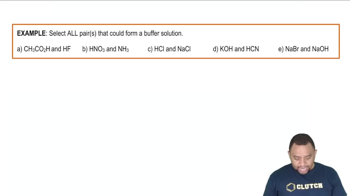
  • Buffer
    A solution that resists significant pH changes by neutralizing added acids or bases.
  • Weak Acid
    An acid that partially dissociates in solution, often used in buffer systems.
  • Conjugate Base
    The species formed when an acid donates a proton, crucial in buffer systems.
  • Hydronium Ion
    A positively charged ion (H3O+) formed when an acid dissolves in water.
  • Hydroxide Ion
    A negatively charged ion (OH-) that can neutralize acids in buffer solutions.
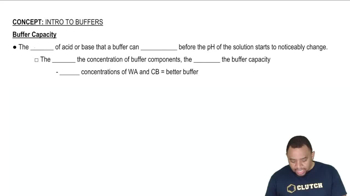
  • Buffer Capacity
    The amount of acid or base a buffer can neutralize without significant pH change.
  • Buffer Range
    The pH range over which a buffer effectively neutralizes added acids or bases.
  • Ideal Buffer
    A buffer with equal concentrations of weak acid and conjugate base, maximizing pH stability.
  • Spectator Ions
    Ions that do not participate in the chemical reaction and remain unchanged.
  • Neutralization
    A chemical reaction in which an acid and a base react to form water and a salt.
  • Ammonium Ion
    A positively charged ion (NH4+) that can act as a weak acid in buffer systems.
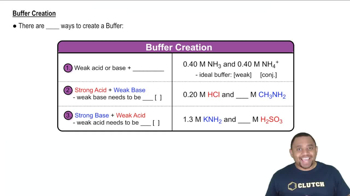
  • Methylamine
    A weak base used in buffer systems, often paired with a strong acid.
  • Potassium Amide
    A strong base used in buffer systems, often paired with a weak acid.
  • Sulfuric Acid
    A diprotic acid that can act as a weak acid in certain buffer systems.
  • Fluoride Ion
    A basic ion that can interact with hydronium ions in buffer solutions.