Intro to Radioactivity definitions Flashcards

Intro to Radioactivity definitions
Control buttons has been changed to "navigation" mode.
1/15
  • Radioactivity
    Spontaneous decomposition of an unstable nucleus, leading to a new element and radiation emission.
  • Isotope
    Atoms of the same element with different mass numbers due to varying numbers of neutrons.
  • Nuclear Reaction
    A process that changes the identity of elements by altering the number of protons.
  • Parent Nuclide
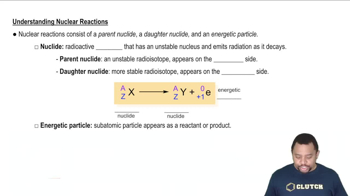
    An unstable radioactive isotope that appears on the reactant side of a nuclear reaction.
  • Daughter Nuclide
    A more stable radioisotope that appears on the product side of a nuclear reaction.
  • Alpha Decay
    A type of radioactivity where an alpha particle is emitted from an unstable nucleus.
  • Beta Decay
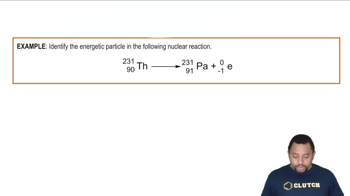
    A radioactive process where a beta particle is emitted from an unstable nucleus.
  • Gamma Emission
    A type of radioactivity involving the emission of gamma rays from an unstable nucleus.
  • Positron Emission
    A radioactive decay process where a positron is emitted from an unstable nucleus.
  • Electron Capture
    A process where an electron is absorbed by the nucleus, appearing on the reactant side.
  • Proton
    A positively charged subatomic particle with a mass number of 1 and atomic number of 1.
  • Neutron
    A neutral subatomic particle with a mass number of 1 and atomic number of 0.
  • Electron
    A negatively charged subatomic particle with negligible mass and atomic number of -1.
  • Positron
    An anti-electron or positively charged electron with negligible mass and atomic number of +1.
  • Energetic Particle
    A particle emitted or absorbed during a nuclear reaction, such as alpha, beta, or positron.