Ka and Kb definitions Flashcards

Ka and Kb definitions
Control buttons has been changed to "navigation" mode.
1/15
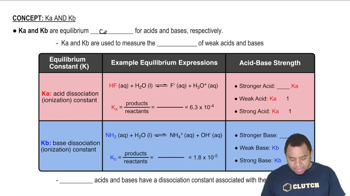
  • Ka
    An equilibrium constant representing the acid dissociation or ionization strength of a weak acid.
  • Kb
    An equilibrium constant representing the base ionization strength of a weak base.
  • Equilibrium Constant
    A ratio of the concentrations of products to reactants, excluding solids and liquids.
  • Hydronium Ion
    A positively charged ion formed when water gains an H+ ion, denoted as H3O+.
  • Hydroxide Ion
    A negatively charged ion formed when water loses an H+ ion, denoted as OH-.
  • Conjugate Acid-Base Pair
    A pair consisting of an acid and its corresponding base, related by the loss or gain of an H+ ion.
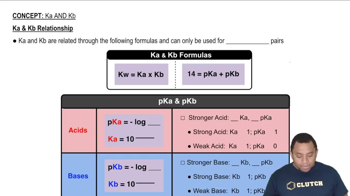
  • Kw
    The ionization constant of water, equal to the product of Ka and Kb for a conjugate pair.
  • pKa
    The negative logarithm of the acid dissociation constant, indicating acid strength.
  • pKb
    The negative logarithm of the base ionization constant, indicating base strength.
  • Ionization
    The process by which an acid or base dissociates into ions in solution.
  • Weak Acid
    An acid with a Ka value less than 1, indicating partial ionization in solution.
  • Weak Base
    A base with a Kb value less than 1, indicating partial ionization in solution.
  • Strong Acid
    An acid with a Ka value greater than 1, indicating complete ionization in solution.
  • Strong Base
    A base with a Kb value greater than 1, indicating complete ionization in solution.
  • Negative Logarithm
    A mathematical operation used to convert Ka and Kb into pKa and pKb, respectively.