Lattice Energy quiz #1 Flashcards

Lattice Energy quiz #1
Control buttons has been changed to "navigation" mode.
1/10
  • What holds metal ions together in a metal lattice?
    Metal ions in a metal lattice are held together by metallic bonds, which involve a 'sea' of delocalized electrons surrounding positively charged metal ions.
  • Is lattice energy usually endothermic or exothermic?
    Lattice energy is usually exothermic because energy is released when gaseous ions combine to form an ionic solid.
  • Which of the following ionic compounds would be expected to have the highest lattice energy: NaCl, MgO, or KBr?
    MgO would be expected to have the highest lattice energy because it has ions with higher charges and smaller radii compared to NaCl and KBr.
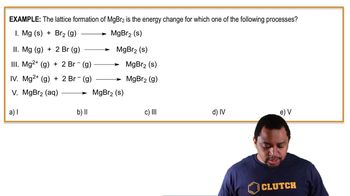
  • The lattice energy of CaF2 is the energy change for which process?
    The lattice energy of CaF2 is the energy change when gaseous Ca2+ and F− ions combine to form solid CaF2.
  • Which of the following correctly ranks the lattice energy of the salts NaCl, KCl, and MgCl2 from lowest to highest?
    KCl < NaCl < MgCl2, because higher ionic charges and smaller ionic radii increase lattice energy.
  • A lattice dissociation enthalpy (lattice energy) is defined as:
    The energy required to break one mole of an ionic solid into its gaseous ions; this process is endothermic.
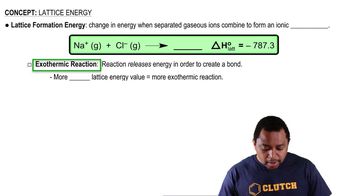
  • How does the sign of delta H differ between lattice formation energy and lattice dissociation energy?
    Delta H is negative for lattice formation energy (exothermic) and positive for lattice dissociation energy (endothermic).
  • What does a more negative lattice energy value indicate about the exothermicity of a reaction?
    A more negative lattice energy value means the reaction is more exothermic and releases more energy when forming the ionic solid.
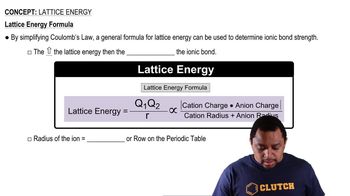
  • According to the lattice energy formula, what effect does increasing ionic radii have on lattice energy?
    Increasing the ionic radii decreases lattice energy because the ions are farther apart, weakening the electrostatic attraction.
  • How does lattice energy affect the solubility of an ionic compound?
    Higher lattice energy results in lower solubility because the ions are held together more tightly, making it harder for the compound to dissolve.