Skip to main content
General Chemistry
My Course
Learn
Exam Prep
AI Tutor
Study Guides
Textbook Solutions
Flashcards
Explore
Try the app
My Course
Learn
Exam Prep
AI Tutor
Study Guides
Textbook Solutions
Flashcards
Explore
Try the app
Back
Le Chatelier's Principle definitions
You can tap to flip the card.
Equilibrium
You can tap to flip the card.
👆
Equilibrium
A state in a chemical reaction where the rates of the forward and reverse reactions are equal, resulting in no net change in concentrations.
Track progress
Control buttons has been changed to "navigation" mode.
1/15
Related flashcards
Related practice
Recommended videos
Le Chatelier's Principle quiz
Le Chatelier's Principle
15 Terms
Le Chatelier's Principle
16. Chemical Equilibrium
7 problems
Topic
Jules
ICE Charts
16. Chemical Equilibrium
7 problems
Topic
Jules
16. Chemical Equilibrium - Part 1 of 2
5 topics
13 problems
Chapter
Jules
16. Chemical Equilibrium - Part 2 of 2
5 topics
13 problems
Chapter
Jules
Guided course
04:04
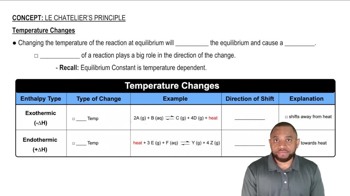
Temperature and Equilibrium Shifts
4101
views
43
rank
1
comments
Guided course
07:32
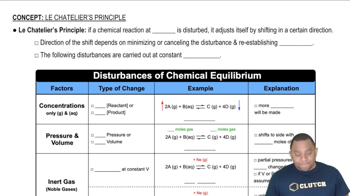
Le Chatelier's Principle
5835
views
55
rank
Guided course
02:50
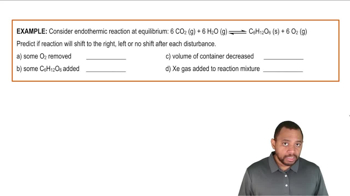
Disturbances and Equilibrium Shifts Example
3924
views
39
rank
Terms in this set (15)
Hide definitions
Equilibrium
A state in a chemical reaction where the rates of the forward and reverse reactions are equal, resulting in no net change in concentrations.
Reactants
Substances initially present in a chemical reaction that are consumed during the reaction to make products.
Products
Substances formed from a chemical reaction, resulting from the conversion of reactants.
Pressure
The force exerted by the gas particles per unit area on the walls of its container, influencing equilibrium shifts.
Volume
The amount of space that a substance or object occupies, inversely related to pressure in gas laws.
Inert Gas
A gas that does not undergo chemical reactions under a set of given conditions, often noble gases.
Catalyst
A substance that increases the rate of a chemical reaction without being consumed, not affecting equilibrium position.
Enthalpy
A measure of the total energy of a thermodynamic system, influencing the direction of equilibrium shifts with temperature changes.
Exothermic
A process or reaction that releases heat to its surroundings, with heat as a product.
Endothermic
A process or reaction that absorbs heat from its surroundings, with heat as a reactant.
Equilibrium Constant (K)
A value that expresses the ratio of products to reactants at equilibrium, dependent on temperature.
Concentration
The amount of a substance per defined space, affecting the direction of equilibrium shifts when altered.
Noble Gases
A group of inert gases including helium, neon, and argon, often used in discussions of inert gas effects.
Forward Direction
The direction in a chemical reaction where reactants are converted into products, often to reestablish equilibrium.
Reverse Direction
The direction in a chemical reaction where products are converted back into reactants, often to reestablish equilibrium.
 BackBack
 04:04
04:04