Lewis Dot Structures: Ions definitions Flashcards

Lewis Dot Structures: Ions definitions
Control buttons has been changed to "navigation" mode.
1/15
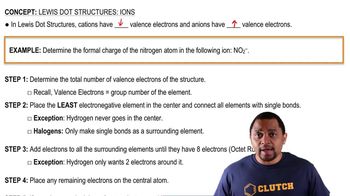
  • Cation
    A positively charged ion formed by the loss of electrons, resulting in fewer valence electrons.
  • Anion
    A negatively charged ion formed by the gain of electrons, resulting in more valence electrons.
  • Valence Electrons
    Electrons in the outermost shell of an atom, crucial for determining chemical bonding.
  • Group Number
    A number indicating the column of an element in the periodic table, used to determine valence electrons.
  • Electronegativity
    A measure of an atom's ability to attract and hold electrons in a chemical bond.
  • Octet Rule
    A principle stating that atoms tend to bond in a way that gives them eight valence electrons.
  • Single Bond
    A chemical bond where two atoms share one pair of electrons.
  • Double Bond
    A chemical bond where two atoms share two pairs of electrons.
  • Triple Bond
    A chemical bond where two atoms share three pairs of electrons.
  • Formal Charge
    A charge assigned to an atom in a molecule, calculated by subtracting bonds and nonbonding electrons from the group number.
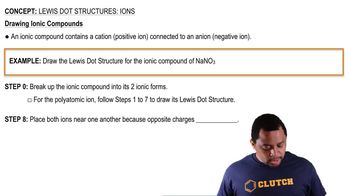
  • Lewis Dot Structure
    A diagram showing the bonding between atoms and the lone pairs of electrons in a molecule.
  • Nitrite Ion
    An ion with the formula NO2-, consisting of nitrogen and oxygen atoms with a total of 18 valence electrons.
  • Nonbonding Electrons
    Electrons in an atom that are not involved in chemical bonding, also known as lone pairs.
  • Brackets
    Symbols used to enclose the Lewis structure of an ion, indicating its charge outside.
  • Halogens
    Elements in Group 7A of the periodic table, typically forming single bonds as surrounding elements.