Back

Limiting Reagent quiz

Control buttons has been changed to "navigation" mode.
1/15
  • What is the limiting reagent in a chemical reaction?

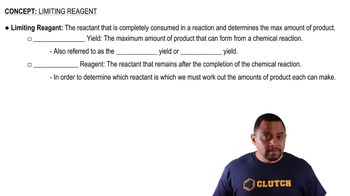
    The limiting reagent is the reactant that is completely consumed first and determines the maximum amount of product that can be formed.
  • Why is the limiting reagent important in chemical reactions?

    It determines the theoretical yield, which is the maximum amount of product that can be produced from the reaction.
  • What is another name for the limiting reagent?

    The limiting reagent is also called the limiting reactant.
  • What is the theoretical yield in a chemical reaction?

    The theoretical yield is the maximum amount of product that can be formed from a chemical reaction, assuming complete consumption of the limiting reagent.
  • What is the excess reagent?

    The excess reagent is the reactant that remains after the chemical reaction is complete.
  • How do you identify the limiting reagent in a reaction with multiple reactants?

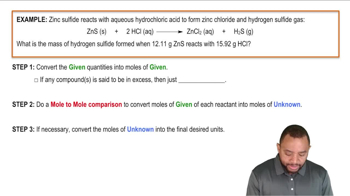
    You perform stoichiometry for each reactant to calculate the amount of product each can produce; the one that produces the least is the limiting reagent.
  • What must you do for each reactant to determine which is limiting?

    You must calculate how much product each reactant can make using stoichiometry.
  • What does the limiting reagent determine besides the theoretical yield?

    It also determines which reactant will be left over (the excess reagent) after the reaction is complete.
  • What is the first step in finding the limiting reagent when given masses of reactants?

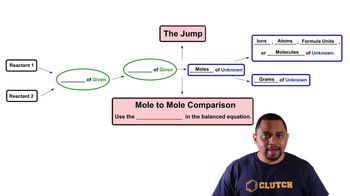
    Convert the given masses of each reactant to moles.
  • What role do coefficients from the balanced equation play in limiting reagent problems?

    They are used to relate the moles of each reactant to the moles of product in stoichiometric calculations.
  • What is different about the stoichiometric chart when dealing with limiting reagents?

    You must perform stoichiometry for each reactant, rather than just one, to determine which is limiting.
  • What happens to the excess reagent after the reaction is complete?

    The excess reagent is not completely consumed and some of it remains after the reaction.
  • Why do you have to do 'double the work' in limiting reagent problems?

    Because you must calculate the amount of product formed from each reactant to identify the limiting reagent.
  • What is meant by '100% yield' in the context of limiting reagents?

    It refers to the theoretical yield, or the maximum possible amount of product if the limiting reagent is completely used up.
  • How does knowing the limiting reagent help in optimizing chemical processes?

    It allows you to predict reaction outcomes and efficiently use materials by knowing which reactant will run out first.