Back

Main Group Elements: Bonding Types quiz

Control buttons has been changed to "navigation" mode.
1/15
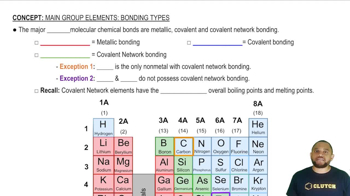
  • Which three major types of intramolecular chemical bonds are found in main group elements?

    Metallic, covalent, and covalent network bonding are the three major types.
  • What type of bonding is characteristic of metals in the main group elements?

    Metals typically exhibit metallic bonding.
  • Which type of bonding is most common among nonmetals?

    Nonmetals most commonly form covalent bonds.
  • What type of bonding do metalloids generally display?

    Metalloids generally display covalent network bonding.
  • Which main group element is a nonmetal but forms covalent network bonds?

    Carbon is a nonmetal that forms covalent network bonds.
  • What are two examples of carbon's covalent network structures?

    Diamond and graphite are two examples of carbon's covalent network structures.
  • Which metalloids do NOT possess covalent network bonding?

    Tellurium and astatine do not possess covalent network bonding.
  • How do the boiling and melting points of covalent network elements compare to other elements?

    Covalent network elements have the greatest overall boiling and melting points among periodic table elements.
  • Are transition metals included when discussing main group element bonding types?

    No, transition metals are not included; only main group elements are considered.
  • What is the typical bonding type for elements in the blue region of the periodic table?

    Elements in the blue region (nonmetals) typically form covalent bonds.
  • What is the typical bonding type for elements in the red region of the periodic table?

    Elements in the red region (metals) typically exhibit metallic bonding.
  • What is the typical bonding type for elements in the green region of the periodic table?

    Elements in the green region (metalloids) typically exhibit covalent network bonding.
  • Why is carbon considered an exception among nonmetals regarding bonding types?

    Carbon is an exception because it forms covalent network bonds, unlike most nonmetals.
  • Do tellurium and astatine follow the typical bonding pattern for metalloids?

    No, tellurium and astatine do not possess covalent network bonding like other metalloids.
  • Which types of chemical bonds are NOT the focus in this lesson about main group elements?

    Ionic bonds and transition metal bonding are not the focus; only metallic, covalent, and covalent network bonds are discussed.