Mass Defect definitions Flashcards

Mass Defect definitions
Control buttons has been changed to "navigation" mode.
1/15
  • Mass Defect
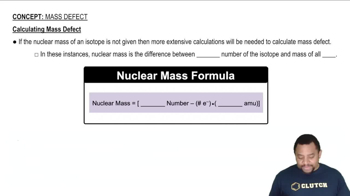
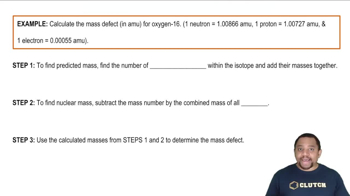
    Difference between predicted mass of an isotope and its actual nuclear mass due to energy conversion.
  • Predicted Mass
    Sum of the masses of all subatomic particles in an element before isotope formation.
  • Nuclear Mass
    Actual mass of an isotope's nucleus, found on the periodic table as atomic mass.
  • Subatomic Particles
    Constituents of an atom, including neutrons, protons, and electrons.
  • Neutron
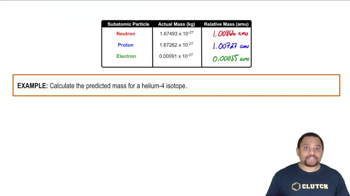
    Subatomic particle with a mass of 1.00866 amu, found in the nucleus.
  • Proton
    Subatomic particle with a mass of 1.00727 amu, found in the nucleus.
  • Electron
    Subatomic particle with a mass of 0.00055 amu, orbiting the nucleus.
  • Atomic Mass Unit
    Unit of mass equal to 1.66 x 10^-27 kilograms, used for subatomic particles.
  • First Law of Thermodynamics
    Principle stating energy cannot be created or destroyed, only transformed.
  • Energy Conversion
    Process where mass lost during isotope formation is transformed into energy.
  • E=mc^2
    Einstein's equation relating mass and energy, allowing conversion between the two.
  • Isotope
    Variant of an element with a specific number of neutrons and protons in the nucleus.
  • Mass Number
    Total number of protons and neutrons in an atom's nucleus.
  • Atomic Mass
    Mass of an atom, typically found on the periodic table, representing nuclear mass.
  • Energy Absorption
    Process where energy is used to break an isotope into its subatomic particles.