Molality quiz #1 Flashcards

Molality quiz #1
Control buttons has been changed to "navigation" mode.
1/10
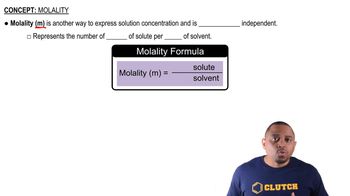
  • Why do we use molality instead of molarity for certain solution concentration calculations?
    Molality is used because it is temperature-independent; it is based on the mass of the solvent rather than the volume of the solution, which can change with temperature.
  • What is the molality of a solution that contains 75.3 g of KCl dissolved in 95.0 g of water?
    First, calculate moles of KCl: 75.3 g / 74.55 g/mol = 1.01 mol. Convert water to kg: 95.0 g = 0.0950 kg. Molality = 1.01 mol / 0.0950 kg = 10.6 mol/kg.
  • What are the units of molality?
    The units of molality are moles of solute per kilogram of solvent (mol/kg).
  • How do you determine the molality of a phosphoric acid solution if given the mass of solute and solvent?
    Calculate moles of phosphoric acid using its molar mass, then divide by the mass of solvent in kilograms: molality = moles of H₃PO₄ / kg of solvent.
  • What is the molality of lithium ions in a 0.302 m solution of Li₃PO₄, assuming complete dissociation?
    Li₃PO₄ dissociates into 3 Li⁺ and 1 PO₄³⁻ per formula unit. Lithium ion molality = 3 × 0.302 m = 0.906 mol/kg.
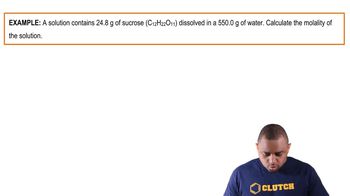
  • What is the molality of a solution prepared from 13.2 g MgCl₂ and 175.0 g H₂O?
    Moles of MgCl₂: 13.2 g / 95.21 g/mol = 0.139 mol. Solvent in kg: 175.0 g = 0.175 kg. Molality = 0.139 mol / 0.175 kg = 0.794 mol/kg.
  • What is the molality of a solution prepared from 12.5 g KNO₃ and 75.0 g H₂O?
    Moles of KNO₃: 12.5 g / 101.1 g/mol = 0.124 mol. Solvent in kg: 75.0 g = 0.0750 kg. Molality = 0.124 mol / 0.0750 kg = 1.65 mol/kg.
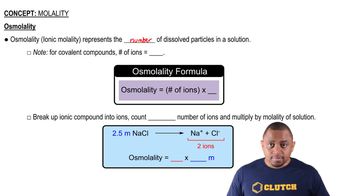
  • How does the calculation of osmolality differ for covalent and ionic compounds?
    For covalent compounds, osmolality equals the molality since they do not dissociate; for ionic compounds, osmolality is the number of ions produced multiplied by the molality.
  • What is the symbol used to represent molality, and why is it significant?
    Molality is represented by a lowercase 'm', which distinguishes it from molarity and emphasizes its temperature independence.
  • If a solution contains 2.5 mol of NaCl, what is its osmolality and why?
    NaCl dissociates into 2 ions, so osmolality is 2 × 2.5 mol = 5 mol; this accounts for all dissolved particles in the solution.