Molecular Orbital Theory definitions Flashcards

Molecular Orbital Theory definitions
Control buttons has been changed to "navigation" mode.
1/15
  • Molecular Orbital
    A region in a molecule where atomic orbitals combine, forming bonding or antibonding interactions.
  • Bonding Molecular Orbital
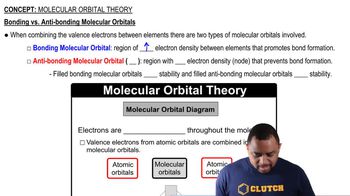
    A molecular orbital with high electron density that promotes bond formation and increases stability.
  • Antibonding Molecular Orbital
    A molecular orbital with a node of low electron density that prevents bond formation and decreases stability.
  • Sigma (σ) Orbital
    A type of bonding molecular orbital characterized by high electron density along the axis connecting two nuclei.
  • Sigma Star (σ*) Orbital
    An antibonding molecular orbital with a node, reducing electron density and bond stability.
  • Node
    A region in an antibonding molecular orbital where electron density is minimal, hindering bond formation.
  • Aufbau Principle
    A rule stating electrons fill atomic orbitals from lowest to highest energy levels.
  • Pauli Exclusion Principle
    A principle stating each orbital can hold two electrons with opposite spins.
  • Hund's Rule
    A rule stating degenerate orbitals are singly filled before pairing electrons.
  • Electron Delocalization
    The spreading of electrons across multiple atoms in a molecule, enhancing stability.
  • Valence Electrons
    Electrons in the outermost shell of an atom, involved in forming molecular orbitals.
  • Atomic Orbital
    A region around an atom's nucleus where electrons are likely to be found.
  • Spin Quantum Number
    A quantum number indicating the intrinsic angular momentum of an electron.
  • Degenerate Orbitals
    Orbitals with the same energy level, filled singly before pairing according to Hund's Rule.
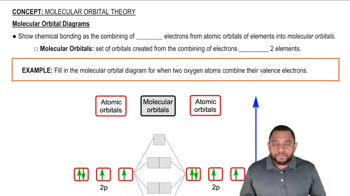
  • Electron Orbital Diagram
    A visual representation of electron distribution in atomic or molecular orbitals.