Which of the following molecules has a bond order of 1.5 according to molecular orbital theory?
O2 (oxygen) has a bond order of 2, but molecules like NO (nitric oxide) and O2+ can have a bond order of 1.5 according to molecular orbital theory, due to the presence of an unpaired electron in the antibonding orbital.
What happens to a molecule when an electron is promoted to an antibonding orbital?
When an electron is promoted to an antibonding orbital, the bond order decreases and the molecule becomes less stable because antibonding orbitals prevent bond formation.
How many linear combinations are possible when two p orbitals are combined?
When two p orbitals are combined, two linear combinations are possible: one bonding molecular orbital and one antibonding molecular orbital.
Which statement is true about the energy levels of bonding and antibonding orbitals?
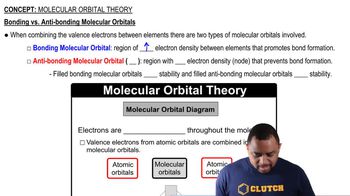
Bonding orbitals have lower energy than the original atomic orbitals, while antibonding orbitals have higher energy.
Which property is better explained by band theory than by the sea-of-electrons model?
Electrical conductivity in metals is better explained by band theory, which describes the delocalization of electrons across energy bands.
Which statement explains how the bands in the crystal of a metal are like atomic orbitals?
Bands in a metal crystal are formed by the overlap of many atomic orbitals, creating continuous ranges of energy levels similar to molecular orbitals but extended throughout the solid.
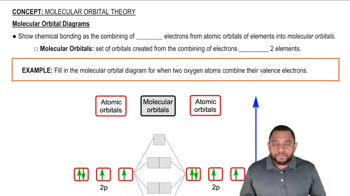
Fill in the molecular orbital energy diagram for the diatomic molecule H2.
For H2, both electrons fill the lower-energy bonding orbital (σ1s), resulting in a bond order of 1. The antibonding orbital (σ*1s) remains empty.
What is the bond order of Ne2+ according to molecular orbital theory?
Ne2+ has a bond order of 0.5, as it has more electrons in antibonding orbitals than in bonding orbitals.
Fill in the molecular orbital energy diagram for the diatomic molecule Li2.
For Li2, the four valence electrons fill the σ2s bonding orbital and the σ*2s antibonding orbital, resulting in a bond order of 1.
What does Hund's Rule state about filling degenerate orbitals in electron configurations?
Hund's Rule states that degenerate orbitals are first filled singly with electrons before any pairing occurs. This minimizes electron repulsion and increases stability.