Back

Octet Rule quiz

Control buttons has been changed to "navigation" mode.
1/15
  • What is the octet rule in chemistry?

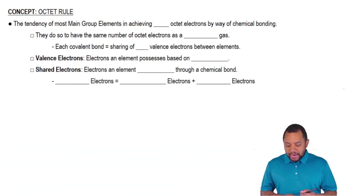
    The octet rule states that most main group elements tend to achieve eight electrons in their valence shell to attain stability, similar to noble gases.
  • How do main group elements typically achieve an octet of electrons?

    They achieve an octet by forming chemical bonds, often covalent, which allow them to share valence electrons with other atoms.
  • What is the relationship between covalent bonds and valence electrons?

    Each covalent bond represents the sharing of two valence electrons between two atoms.
  • How do you calculate the total number of octet electrons for an atom?

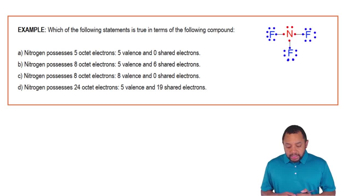
    Octet electrons are the sum of an atom's valence electrons and the electrons it shares through chemical bonds.
  • Why is hydrogen an exception to the octet rule?

    Hydrogen only needs one valence electron to achieve the noble gas configuration of helium, so it does not follow the octet rule.
  • What is an incomplete octet, and which elements commonly have them?

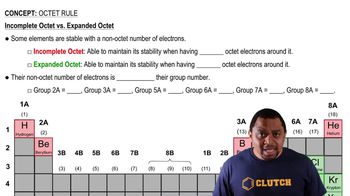
    An incomplete octet occurs when an element is stable with fewer than eight electrons; common examples include hydrogen, helium, beryllium, boron, aluminum, gallium, and indium.
  • What is an expanded octet, and which elements can have them?

    An expanded octet occurs when an element is stable with more than eight electrons, typically seen in period 3 and lower elements like phosphorus, sulfur, chlorine, and others.
  • Why can elements in period 3 and below have expanded octets?

    These elements have larger electron shells, allowing them to accommodate more than eight electrons in their valence shell.
  • How is the number of electrons in a non-octet element often determined?

    The number of electrons in a non-octet element is typically twice its group number.
  • Which group 2A element is stable with only four valence electrons?

    Beryllium, a group 2A element, is stable with only four valence electrons.
  • Name three elements that commonly have incomplete octets.

    Hydrogen, helium, and boron commonly have incomplete octets.
  • Why are noble gases generally unreactive in terms of the octet rule?

    Noble gases are already stable with a complete octet and thus do not tend to form bonds.
  • What is the typical number of octet electrons for a group 3A element?

    A group 3A element is typically stable with six octet electrons.
  • Give an example of an element that can have 12 octet electrons.

    Elements in group 6A, such as sulfur, can have 12 octet electrons due to their ability to expand their valence shell.
  • What is the main reason for exceptions to the octet rule?

    Exceptions occur because some elements are stable with fewer or more than eight electrons, depending on their size and electron shell capacity.