Back

Osmosis quiz #1

Control buttons has been changed to "navigation" mode.
1/38
  • Which best describes the difference between osmosis and diffusion?

    Osmosis is the movement of water across a semipermeable membrane from a region of lower solute concentration to higher solute concentration, while diffusion is the movement of molecules from an area of high concentration to low concentration without the need for a membrane.
  • How does osmosis differ from diffusion?

    Osmosis specifically involves the movement of water across a semipermeable membrane, whereas diffusion can involve any type of molecule moving from high to low concentration.
  • True or false? Osmosis is a type of diffusion.

    True
  • What happens when Elodea leaves are placed in a 10% NaCl solution?

    The cells in the Elodea leaves will lose water and shrink due to the hypertonic nature of the NaCl solution.
  • In osmosis, in which direction does water move relative to solute concentration?

    Osmosis involves water moving from low to high solute concentration.
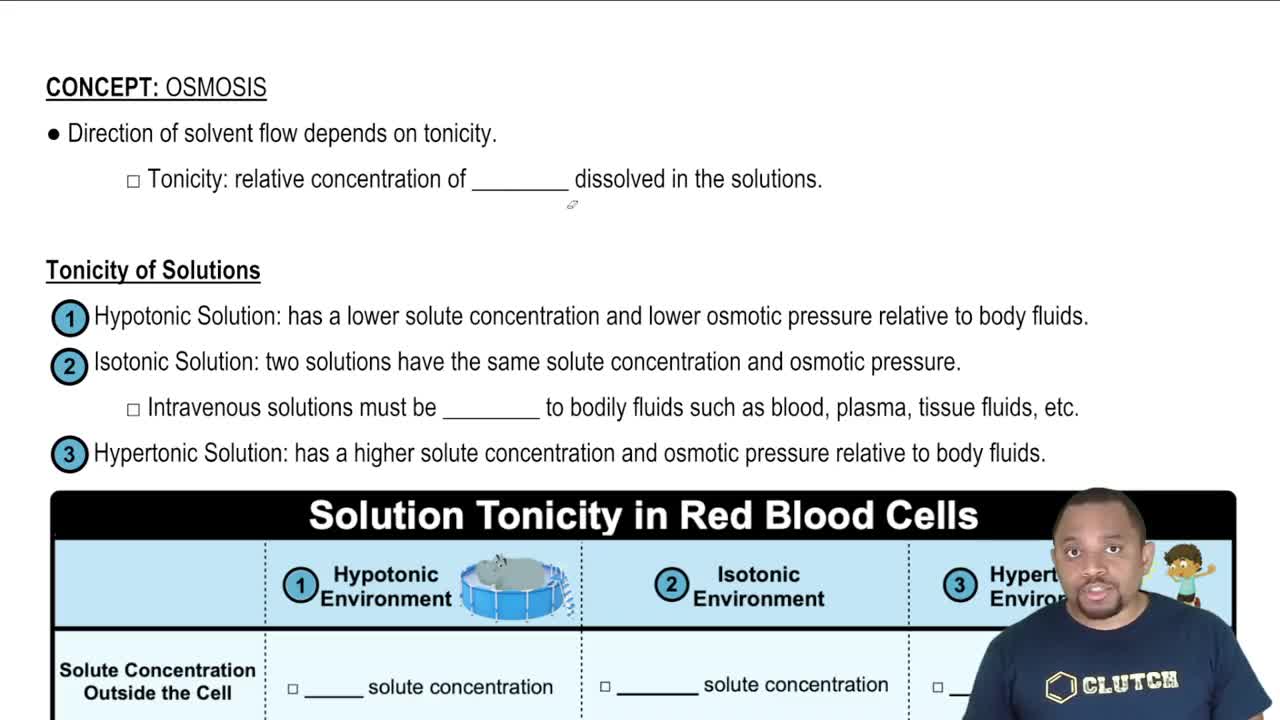
  • In which kind of solution is the concentration of solutes the same inside and outside of the cell?

    Isotonic solution
  • What is the term for the diffusion of water across a semipermeable membrane?

    Osmosis
  • How is osmosis different from simple diffusion?

    Osmosis specifically involves the movement of water across a semipermeable membrane, while simple diffusion involves the movement of any molecules from high to low concentration.
  • Why does a hypertonic solution cause a cell to shrink?

    Water exits the cell.
  • What two conditions must be present for osmosis to occur?

    A semipermeable membrane and a concentration gradient.
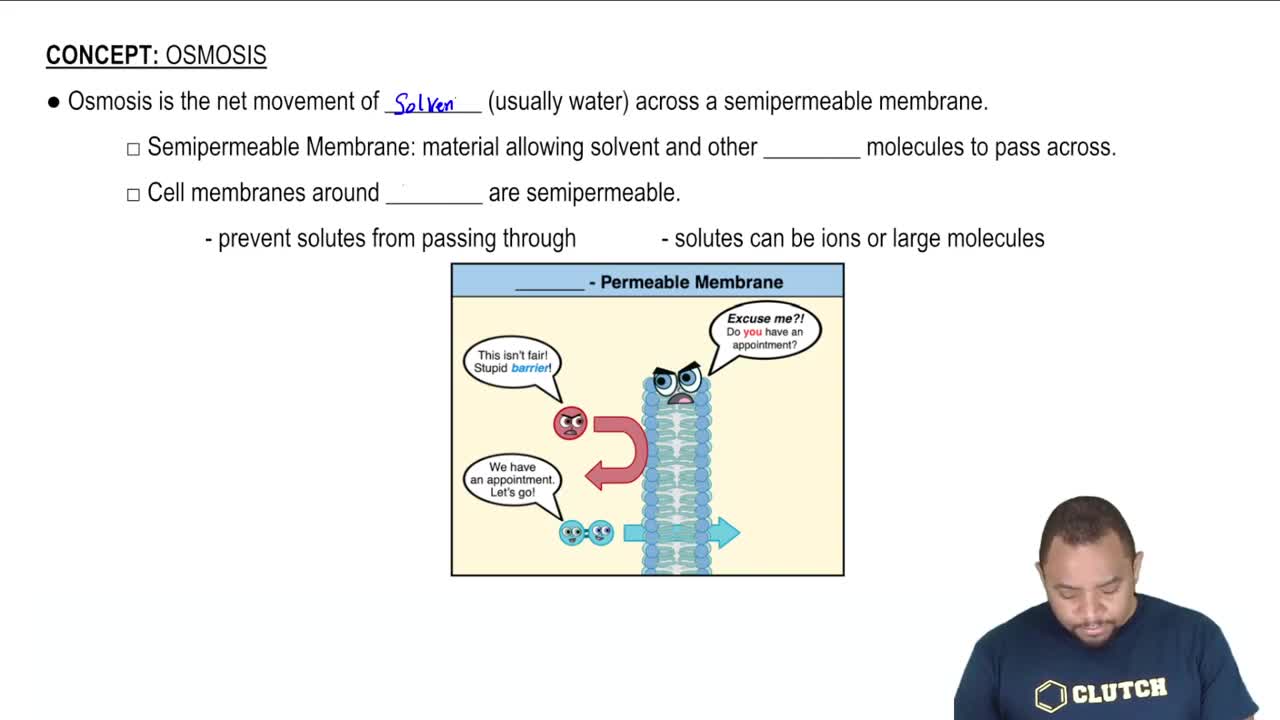
  • What does water pass through during osmosis?

    A semipermeable membrane
  • Which term is used exclusively to describe water's movement across a selectively permeable membrane?

    Osmosis
  • What occurs during osmosis?

    Water moves across a semipermeable membrane from a region of lower solute concentration to higher solute concentration.
  • Why does osmosis occur?

    Osmosis occurs due to the concentration gradient of solutes across a semipermeable membrane.
  • How is osmosis different from diffusion?

    Osmosis involves water moving across a semipermeable membrane, while diffusion involves any molecules moving from high to low concentration.
  • During osmosis, water will move in which direction?

    From a region of lower solute concentration to a region of higher solute concentration.
  • If a membrane is impermeable to solutes, what effect does this have on osmosis?

    Osmosis will still occur, as it involves the movement of water, not solutes.
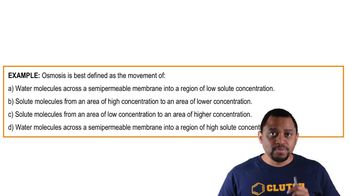
  • What is osmosis?

    Movement of water across a semipermeable membrane
  • How is osmosis related to diffusion?

    Osmosis is a specific type of diffusion involving water moving across a semipermeable membrane.
  • What does osmosis move across a membrane?

    It moves water
  • Which process does osmosis involve?

    The passive movement of water across a semipermeable membrane.
  • Will osmosis occur if there is no concentration gradient?

    No, osmosis requires a concentration gradient to drive the movement of water.
  • What is the role of osmosis in the dialysis process?

    Osmosis helps remove excess water from the blood during dialysis.
  • What is the term for the diffusion of water?

    Osmosis
  • How do water molecules move during osmosis?

    Water molecules move from a region of lower solute concentration to a region of higher solute concentration.
  • In what direction do water molecules move through a semi-permeable membrane?

    From a region of lower solute concentration to a region of higher solute concentration.
  • What is the passive movement of molecules from areas of high concentration to low concentration?

    Diffusion
  • What factor does not speed up the net rate of diffusion for glucose into a cell?

    Increasing solute size
  • Osmosis is the diffusion of what?

    Water
  • How does osmosis work?

    Osmosis works by moving water across a semipermeable membrane from a region of lower solute concentration to higher solute concentration.
  • Which type of organism loses the most water by osmosis across its gills?

    Saltwater fish
  • Why do plants wilt if they are watered with a salt solution?

    Water exits the cells
  • What does osmosis move and does it require energy?

    It moves water
  • What are the similarities between the processes of diffusion and osmosis?

    Both are passive transport processes that move molecules from areas of high concentration to low concentration.
  • How do osmosis and diffusion differ?

    Osmosis specifically involves water moving across a semipermeable membrane, while diffusion involves any molecules moving from high to low concentration.
  • What type of proteins assist with moving water through the cell membrane during osmosis?

    Aquaporins
  • Which term refers to the diffusion of water across a selectively permeable membrane?

    Osmosis
  • What must water pass through during osmosis?

    A semipermeable membrane