Back

Paramagnetism and Diamagnetism quiz

Control buttons has been changed to "navigation" mode.
1/15
  • What is the maximum number of electrons that can occupy a single orbital?

    A single orbital can hold a maximum of 2 electrons.
  • What principle states that electrons in the same orbital must have opposite spins?

    The Pauli exclusion principle states that electrons in the same orbital must have opposite spins.
  • What is the key characteristic of a paramagnetic substance?

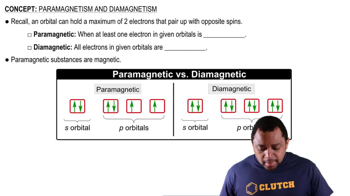
    A paramagnetic substance has at least one unpaired electron in its orbitals.
  • How are the electrons arranged in a diamagnetic substance?

    In a diamagnetic substance, all electrons are paired in their orbitals.
  • How do paramagnetic substances respond to magnetic fields?

    Paramagnetic substances are attracted to magnetic fields.
  • How do diamagnetic substances respond to magnetic fields?

    Diamagnetic substances are not attracted and may be slightly repelled by magnetic fields.
  • What is an example of a paramagnetic molecule and why?

    Oxygen (Oā‚‚) is paramagnetic because it has unpaired electrons.
  • What is an example of a diamagnetic molecule and why?

    Nitrogen (Nā‚‚) is diamagnetic because all its electrons are paired.
  • What must be true about the electrons in every orbital for a substance to be diamagnetic?

    Every orbital must contain two paired electrons for a substance to be diamagnetic.
  • If an atom has one unpaired electron, is it paramagnetic or diamagnetic?

    It is paramagnetic because it has at least one unpaired electron.
  • What should you check in an electron configuration to determine if a substance is paramagnetic?

    Check if there is at least one unpaired electron in any orbital.
  • What should you check in an electron configuration to determine if a substance is diamagnetic?

    Check that all electrons are paired in every orbital.
  • Why are paramagnetic substances considered magnetic?

    They are influenced by magnetic fields due to the presence of unpaired electrons.
  • What happens to the electrons in the s and p orbitals of a diamagnetic atom?

    All electrons in the s and p orbitals are paired in a diamagnetic atom.
  • Can an ion be paramagnetic, and if so, under what condition?

    Yes, an ion is paramagnetic if it has at least one unpaired electron in its orbitals.