Periodic Trend: Effective Nuclear Charge quiz #1 Flashcards

Periodic Trend: Effective Nuclear Charge quiz #1
Control buttons has been changed to "navigation" mode.
1/27
  • Which periodic trend is not explained by shielding and effective nuclear charge (Zeff)?
    Electronegativity trend down a group is not fully explained by shielding and Zeff; other factors like atomic size also play a role.
  • Which family on the periodic table has the highest effective nuclear charge?
    The noble gases (Group 18) have the highest effective nuclear charge for their valence electrons.
  • Would you expect the shielding effect to be greater in bromine than in chlorine?
    Yes, bromine has more inner electrons than chlorine, resulting in a greater shielding effect.
  • Which of the following is not a property affected by the effective nuclear charge?
    Color is not a property directly affected by effective nuclear charge.
  • What is the effective nuclear charge for neon?
    For neon, Zeff = atomic number (10) - shielding constant (core electrons, 2 for 1s2 and 8 for 2s2 2p6). For valence electrons, Zeff ≈ 10 - 2 = 8.
  • What is electron shielding?
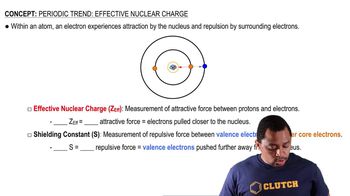
    Electron shielding is the repulsion of valence electrons by inner core electrons, reducing the net attraction to the nucleus.
  • What is the effective nuclear charge for the valence electrons in chlorine?
    For chlorine, Zeff = atomic number (17) - shielding constant (core electrons, 10), so Zeff ≈ 7.
  • What is the effective nuclear charge for the valence electrons in phosphorus?
    For phosphorus, Zeff = atomic number (15) - shielding constant (core electrons, 10), so Zeff ≈ 5.
  • What is the effective nuclear charge of carbon?
    For carbon, Zeff = atomic number (6) - shielding constant (core electrons, 2), so Zeff ≈ 4.
  • Which of the following elements will have the greatest effective nuclear charge?
    Fluorine will have the greatest effective nuclear charge among main-group elements in its period.
  • Which statement is true about effective nuclear charge?
    Effective nuclear charge increases across a period from left to right.
  • Which element has atoms that most likely have the greatest shielding effect?
    Elements with the most inner electrons, such as cesium or francium, have the greatest shielding effect.
  • Which would you expect to experience a greater effective nuclear charge: a 2p electron in oxygen or a 2p electron in fluorine?
    A 2p electron in fluorine experiences a greater effective nuclear charge than in oxygen.
  • Which statement is true about the effective nuclear charge (Zeff)?
    Zeff is the net positive charge experienced by an electron after accounting for shielding by inner electrons.
  • What is the effective nuclear charge for oxygen?
    For oxygen, Zeff = atomic number (8) - shielding constant (core electrons, 2), so Zeff ≈ 6.
  • What is the nuclear charge of bromine?
    The nuclear charge of bromine is its atomic number, which is 35.
  • Which atom has the greatest nuclear charge?
    The atom with the highest atomic number, such as oganesson (Og, atomic number 118), has the greatest nuclear charge.
  • Which element has the greater effective nuclear charge: sodium or magnesium?
    Magnesium has a greater effective nuclear charge than sodium.
  • What is the effective nuclear charge for silver?
    For silver (atomic number 47), Zeff ≈ 47 minus the number of core electrons (36), so Zeff ≈ 11.
  • What is the effective nuclear charge experienced by a 2s electron in a beryllium atom?
    For beryllium, Zeff = atomic number (4) - shielding constant (core electrons, 2), so Zeff ≈ 2.
  • What is the effective nuclear charge of a 3s electron in a sodium atom?
    For sodium, Zeff = atomic number (11) - shielding constant (core electrons, 10), so Zeff ≈ 1.
  • Which of the following trends is inversely proportional to effective nuclear charge?
    Atomic radius is inversely proportional to effective nuclear charge.
  • From left to right across a period for main-group elements, the effective nuclear charge...
    ...increases as you move from left to right across a period.
  • Which factor would be most likely to shrink the size of an atom’s electron cloud?
    An increase in effective nuclear charge would shrink the size of an atom’s electron cloud.
  • Effective nuclear charge, Zeff, is defined as...
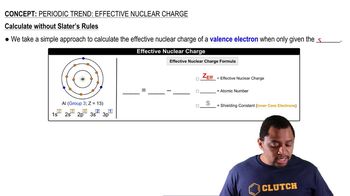
    ...the net positive charge experienced by an electron, calculated as atomic number minus shielding constant.
  • Calculate the effective nuclear charge on a valence electron in a bromine atom.
    For bromine, Zeff = atomic number (35) - shielding constant (core electrons, 28), so Zeff ≈ 7.
  • Which of the following is not a property affected by the effective nuclear charge, Zeff?
    Melting point is not directly affected by effective nuclear charge.