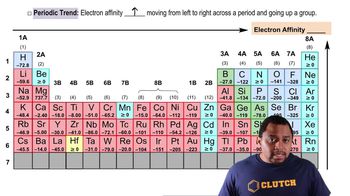
What are the observed periodic trends in electron affinity?
Electron affinity generally becomes more negative (more exothermic) as you move across a period to the right and up a group in the periodic table.
Which reaction below represents the electron affinity of lithium?
Li(g) + e⁻ → Li⁻(g)
The affinity of an atom for an electron is also known as which of the following?
Electron affinity.
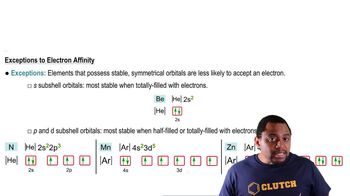
Why are electron affinity values for the noble gases endothermic?
Noble gases have completely filled orbitals, making them stable and reluctant to accept additional electrons, so adding an electron requires energy (endothermic).
Which one of the following is most likely to gain electrons when forming an ion?
Nonmetals, especially those near the top right of the periodic table, are most likely to gain electrons when forming ions.
Which element has the lowest electron affinity?
Noble gases, such as argon, have the lowest electron affinity (often close to zero or positive).
Which element has a partially filled atomic orbital?
Elements like carbon have partially filled atomic orbitals.
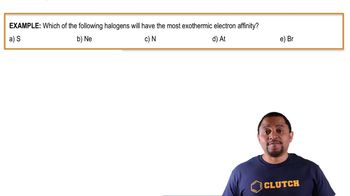
For which of the following elements will gaining an electron be the most exothermic process?
Fluorine will have the most exothermic process when gaining an electron.
Why don’t noble gases normally form chemical bonds?
Noble gases have completely filled valence shells, making them stable and unlikely to form chemical bonds.
Why can period 1 contain a maximum of two elements?
Period 1 contains only hydrogen and helium because the first energy level (1s) can hold a maximum of two electrons.
For which element is the gaining of an electron most exothermic?
Fluorine.
Which reaction below represents the electron affinity of potassium?
K(g) + e⁻ → K⁻(g)
Which element has the highest (most negative) electron affinity?
Fluorine.
Which type of element is likely to have a higher electron affinity?
Nonmetals, especially those near the top right of the periodic table.
Which element has the most negative electron affinity?
Fluorine.
Which element has the highest electron affinity (most negative value)?
Fluorine.
Which of the following elements has the greatest electron affinity (largest positive value)?
Noble gases, such as argon, have the largest positive (least negative) electron affinity.
Which of the following correctly represents the electron affinity of bromine?
Br(g) + e⁻ → Br⁻(g)
What is the trend in electron affinity down a group?
Electron affinity becomes less negative (less exothermic) as you move down a group.
Why does carbon have a more exothermic electron affinity than nitrogen?
Carbon's p orbitals are not half-filled, so adding an electron increases stability, while nitrogen's p orbitals are half-filled and stable, making it less favorable to add an electron.
What does a more negative electron affinity mean?
A more negative electron affinity means the atom releases more energy when gaining an electron, indicating a stronger tendency to accept electrons.
What is the general trend for electron affinity values going across a period?
Electron affinity generally becomes more negative (more exothermic) as you move from left to right across a period.
Which element has the most favorable (most negative) electron affinity?
Fluorine.
Which of these elements will release the most energy when gaining an electron?
Fluorine.
Which element would have the largest (most exothermic) value of first electron affinity (EA1)?
Fluorine.
The elements of which group in the periodic table absorb the most energy when gaining an electron?
Noble gases.
Which element would most likely have an electron affinity measuring closest to zero? Na, Al, Rb, Ar
Argon (Ar) would have an electron affinity closest to zero.
The most negative electron affinity is most likely associated with which type of atoms?
Nonmetals near the top right of the periodic table.
Which correctly summarizes the trend in electron affinity?
Electron affinity becomes more negative across a period and less negative down a group, with exceptions for elements with filled or half-filled orbitals.
Which element would most likely have an electron affinity measuring closest to zero?
A noble gas, such as argon.
Which of the following elements can form compounds with an expanded octet?
Elements in period 3 and beyond, such as phosphorus, sulfur, and chlorine, can form compounds with expanded octets.
Of the following, which would you expect to have the largest electron affinity?
Fluorine.
Arrange the following elements from greatest to least tendency to accept an electron.
Fluorine > Oxygen > Nitrogen > Carbon.
Which alkaline earth metal has the highest electron affinity?
Beryllium and magnesium have low electron affinities, but among alkaline earth metals, magnesium has a slightly higher electron affinity than beryllium.
Identify which of the following atoms would have the greatest electron affinity.
Fluorine.
Arrange these elements according to electron affinity.
Fluorine > Chlorine > Bromine > Iodine.
Arrange these elements according to electron affinity.