Back

Periodic Trend: Electronegativity quiz

Control buttons has been changed to "navigation" mode.
1/15
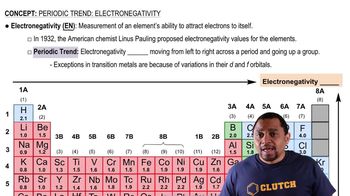
  • Who introduced the concept of electronegativity and in what year?

    Linus Pauling introduced the concept of electronegativity in 1932.
  • What does electronegativity measure?

    Electronegativity measures an element's ability to attract electrons to itself.
  • How does electronegativity differ from electron affinity?

    Electronegativity is about attracting electrons, while electron affinity is the energy released when an electron is added to an element.
  • What is the trend of electronegativity across a period on the periodic table?

    Electronegativity increases from left to right across a period.
  • What is the trend of electronegativity within a group on the periodic table?

    Electronegativity increases from bottom to top within a group.
  • Which element is the most electronegative?

    Fluorine is the most electronegative element on the periodic table.
  • Which element is the least electronegative?

    Francium is the least electronegative element on the periodic table.
  • Why do some noble gases lack electronegativity values?

    Noble gases typically lack electronegativity values because they are generally unreactive and do not attract electrons.
  • Why are transition metals exceptions to the general electronegativity trend?

    Transition metals are exceptions due to variations in their d and f orbitals, which affect their electronegativity values.
  • What happens to electronegativity as you move toward the top right corner of the periodic table?

    Electronegativity increases as you move toward the top right corner of the periodic table.
  • Why are many elements in the bottom row of the periodic table missing electronegativity values?

    Many bottom row elements are too large and unstable, so their electronegativity values are not typically discussed.
  • What is the abbreviation for electronegativity?

    The abbreviation for electronegativity is 'EN.'
  • How does the addition of an electron to a gaseous element relate to electron affinity?

    When an electron is added to a gaseous element, the energy released is called electron affinity.
  • Why is understanding electronegativity trends important in chemistry?

    Understanding electronegativity trends is essential for predicting molecule behavior and bond formation.
  • What is a common misconception between electronegativity and electron affinity?

    A common misconception is that electronegativity and electron affinity are the same, but they measure different properties.