Periodic Trend: Metallic Character quiz #1 Flashcards
Periodic Trend: Metallic Character quiz #1
You can tap to flip the card.
Control buttons has been changed to "navigation" mode.
1/40
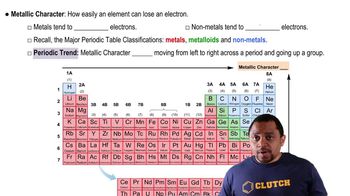
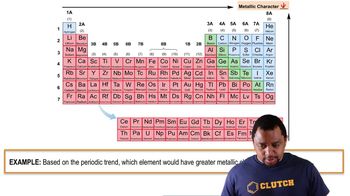
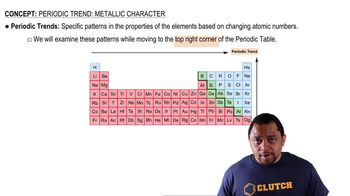
Which element on the periodic table is the most reactive metal?Cesium is considered the most reactive metal due to its high metallic character and ease of losing electrons.Which element is most likely to bend without breaking?Metals, such as gold or copper, are most likely to bend without breaking due to their malleability.Which element is likely to be the best conductor of electricity: copper, lithium, iodine, or silicon?Copper is the best conductor of electricity among the listed elements because it is a metal with high metallic character.What property do all of the group 18 elements have that makes them stand out from other elements?Group 18 elements (noble gases) are chemically inert and rarely react with other elements due to their full valence electron shells.Which metalloids would behave more like metals?Metalloids closer to the left side of the periodic table, such as silicon and germanium, behave more like metals.Which property would cesium most likely have?Cesium is highly reactive and has strong metallic character, easily losing electrons.Which category of elements have the property of being malleable and ductile?Metals are malleable and ductile, allowing them to be shaped and stretched without breaking.Which element is more chemically reactive: sodium or magnesium?Sodium is more chemically reactive than magnesium because it has a higher metallic character.In which direction on the periodic table does metallic character increase?Metallic character increases as you move from right to left across a period and from top to bottom down a group.Which element is likely to be the most brittle?Nonmetals, such as sulfur, are likely to be the most brittle.Are the noble gases reactive?Noble gases are generally unreactive due to their full valence electron shells.Which of the following elements is the most reactive: sodium, magnesium, or aluminum?Sodium is the most reactive among these elements because it has the highest metallic character.Which group has the greatest metallic character?Group 1 (alkali metals) has the greatest metallic character.Which element is likely more reactive: potassium or calcium?Potassium is more reactive than calcium due to its higher metallic character.Which physical property of metalloids is like that of nonmetals?Metalloids can be brittle, similar to nonmetals.Which is a property of metals?Metals are good conductors of electricity.Which of these elements is the most chemically reactive: lithium, beryllium, or boron?Lithium is the most chemically reactive due to its high metallic character.Which of the following elements would be the most reactive with other elements: sodium, chlorine, or argon?Sodium is the most reactive with other elements because it is a metal with high metallic character.Which element listed is likely to be the most reactive: cesium, iron, or gold?Cesium is likely to be the most reactive due to its strong metallic character.What happens as you move down group 1 on the periodic table?Metallic character and reactivity increase as you move down group 1.Which property of metals is the result of light reflecting off the electrons?Luster is the property of metals resulting from light reflecting off their electrons.Which elements are the most reactive?Alkali metals (group 1) are the most reactive metals.Which of the following elements would you expect to lose electrons in chemical changes?Metals are expected to lose electrons in chemical changes.What are the characteristics of metals?Metals are malleable, ductile, lustrous, and good conductors of electricity.Which of these elements do you think is most reactive: sodium, magnesium, or aluminum?Sodium is the most reactive due to its high metallic character.Which property differentiates metalloids from metals and nonmetals?Metalloids have intermediate properties between metals and nonmetals, such as semi-conductivity.What physical properties are used to classify elements as metals?Malleability, ductility, luster, and electrical conductivity are used to classify metals.Which of these elements is the most chemically active: potassium, calcium, or zinc?Potassium is the most chemically active due to its high metallic character.Why don't noble gases react much with other elements?Noble gases have full valence electron shells, making them chemically inert.Which element is malleable and ductile?Copper is malleable and ductile.Which of the following period 4 elements would be most likely to lose electrons to form a cation: potassium, calcium, or iron?Potassium is most likely to lose electrons to form a cation.Which elements most easily give up electrons?Metals, especially those in group 1, most easily give up electrons.Which of the following lists the elements in order of decreasing malleability: gold, silver, copper, iron?Gold > Silver > Copper > Iron in order of decreasing malleability.Which of the properties listed typically apply to metals?Metals are malleable, ductile, lustrous, and good conductors of electricity.Which of the following is a defining property of noble gases?Noble gases are chemically inert and rarely react with other elements.Why do elements in the same group of the periodic table have similar properties?Elements in the same group have similar valence electron configurations, leading to similar properties.Which of the following elements is the most chemically active: sodium, magnesium, or aluminum?Sodium is the most chemically active due to its high metallic character.Which elements are least likely to react with other elements?Noble gases are least likely to react with other elements.What properties are generally the same for elements within the same group?Elements in the same group have similar chemical reactivity and valence electron configurations.Which elements are the least reactive on the periodic table?Noble gases are the least reactive elements.