Pearson+ LogoPearson+ Logo

pH of Strong Acids and Bases quiz #1 Flashcards

Back
pH of Strong Acids and Bases quiz #1
Control buttons has been changed to "navigation" mode.
1/20
  • What is the pH of a 2.8 M solution of HClO4, a strong acid?

    Since HClO4 is a strong acid, it completely ionizes in water. Therefore, the concentration of H+ ions is equal to the acid concentration: [H+] = 2.8 M. The pH is calculated as pH = -log[H+]. Thus, pH = -log(2.8) ≈ -0.45.
  • What is the relationship between the concentration of a strong acid and the concentration of H+ ions in solution?

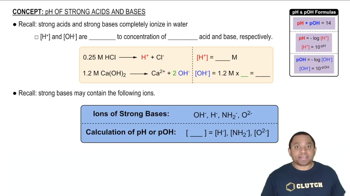
    For strong acids, the concentration of H+ ions is equal to the initial concentration of the acid because they completely ionize in water.
  • How does the number of hydroxide ions produced by calcium hydroxide affect the calculation of [OH-]?

    Calcium hydroxide produces two hydroxide ions per molecule, so the [OH-] is twice the initial molarity of Ca(OH)2.
  • Which four anions are considered when calculating the basicity of strong bases?

    The four basic anions are hydroxide (OH-), hydride (H-), amide (NH2-), and oxide (O2-).
  • What is the formula that relates pH and pOH in aqueous solutions?

    The formula is pH + pOH = 14.
  • How do you calculate the pOH from the concentration of OH- ions?

    pOH is calculated as the negative logarithm of the OH- concentration: pOH = -log[OH-].
  • If you know the pOH of a solution, how can you find the concentration of OH- ions?

    The concentration of OH- ions is found using [OH-] = 10^(-pOH).
  • What happens to the concentration of ions when a strong acid or base ionizes in water?

    The concentration of ions produced is equal to the initial concentration of the strong acid or base due to complete ionization.
  • How do you determine the concentration of H+ ions from a known pH value?

    The concentration of H+ ions is calculated as [H+] = 10^(-pH).
  • Why is it important to consider the number of ions produced per formula unit when calculating ion concentrations for strong bases?

    Because some strong bases produce more than one ion per formula unit, which increases the total ion concentration in solution.
  • How do you calculate the pH of a solution of a strong acid, such as HNO₃, given its molarity?

    For a strong acid like HNO₃, which completely ionizes, the concentration of H+ ions equals the acid's molarity. The pH is calculated as pH = -log[H+], where [H+] is the molarity of the acid.
  • What is the method to determine the pH of a strong base solution, such as 0.050 M LiOH?

    For a strong base like LiOH, which fully ionizes, the concentration of OH- equals the base's molarity. First, calculate pOH = -log[OH-], then use pH = 14 - pOH.
  • How do you find the pH of a 0.0040 M solution of Ca(OH)₂?

    Ca(OH)₂ is a strong base that produces two OH- ions per formula unit. The [OH-] is 0.0040 M × 2 = 0.0080 M. Calculate pOH = -log(0.0080), then pH = 14 - pOH.
  • What does it mean for an acid like HCl to be classified as a strong acid?

    A strong acid like HCl completely ionizes in water, so the concentration of H+ ions equals the initial concentration of the acid.
  • How do you calculate the pH of a 0.00125 M HCl solution?

    Since HCl is a strong acid, [H+] = 0.00125 M. The pH is calculated as pH = -log(0.00125).
  • What steps are involved in finding the pH of a 0.001 M NaOH solution?

    NaOH is a strong base, so [OH-] = 0.001 M. Calculate pOH = -log(0.001), then pH = 14 - pOH.
  • How do you determine the pH of a 1.00 M NaOH solution?

    For 1.00 M NaOH, [OH-] = 1.00 M. Calculate pOH = -log(1.00) = 0, then pH = 14 - 0 = 14.
  • What is the procedure for calculating the pH of a 0.000100 M solution of HBr?

    HBr is a strong acid, so [H+] = 0.000100 M. The pH is found using pH = -log(0.000100).
  • How do you find the pH of a 0.0235 M HCl solution?

    Since HCl is a strong acid, [H+] = 0.0235 M. The pH is calculated as pH = -log(0.0235).
  • What is the method for determining the pH of an 8.5 × 10⁻³ M HI solution?

    HI is a strong acid, so [H+] = 8.5 × 10⁻³ M. The pH is calculated as pH = -log(8.5 × 10⁻³).