Back

Phase Diagrams quiz

Control buttons has been changed to "navigation" mode.
1/15
  • What does a phase diagram represent for a pure substance?

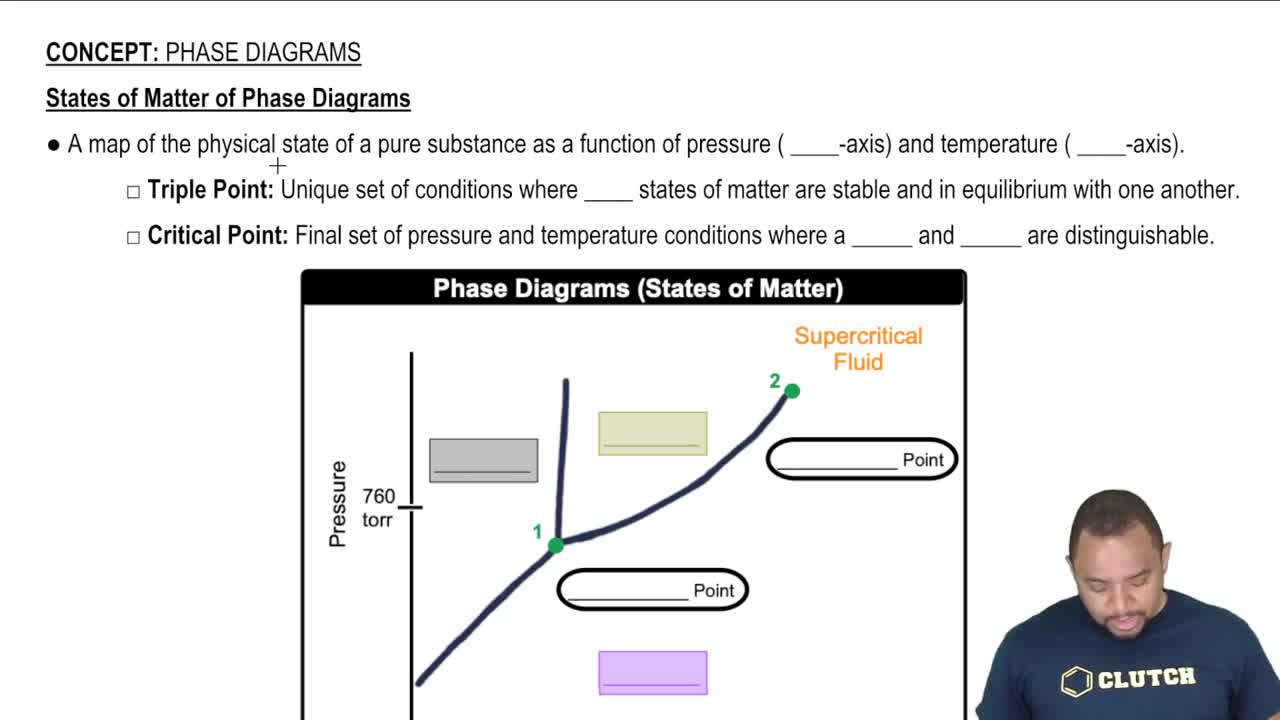
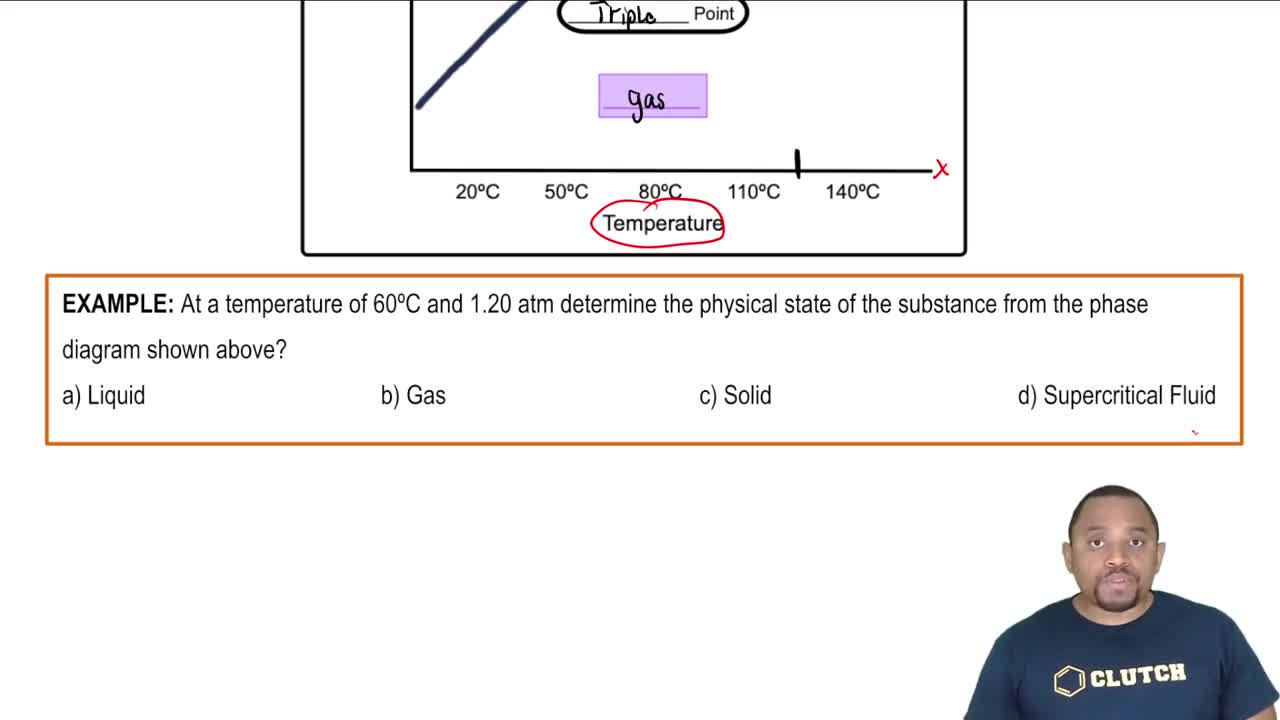
    A phase diagram shows the physical state (solid, liquid, gas) of a pure substance as a function of temperature (x-axis) and pressure (y-axis).
  • What is the triple point on a phase diagram?

    The triple point is the unique set of conditions where all three states of matter (solid, liquid, gas) are in equilibrium.
  • Where are pressure and temperature located on a typical phase diagram?

    Pressure is on the y-axis and temperature is on the x-axis of a phase diagram.
  • What does the critical point on a phase diagram represent?

    The critical point is the final set of pressure and temperature conditions where liquid and gas are indistinguishable, beyond which a supercritical fluid exists.
  • What is a supercritical fluid?

    A supercritical fluid is a state beyond the critical point where the substance is neither a true liquid nor a true gas.
  • What phase is favored at high pressure and low temperature on a phase diagram?

    The solid phase is favored at high pressure and low temperature.
  • What is the process called when a solid turns directly into a gas?

    The process is called sublimation.
  • What is the name for the phase change from solid to liquid?

    The phase change from solid to liquid is called melting or fusion.
  • What is the phase change from liquid to gas called?

    The phase change from liquid to gas is called vaporization.
  • What is a phase change curve on a phase diagram?

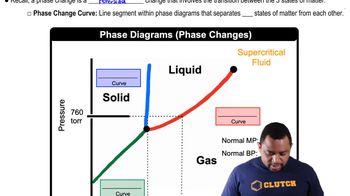
    A phase change curve is a line segment on the diagram that separates two states of matter, indicating where phase transitions occur.
  • What is the normal pressure value used in phase diagrams?

    Normal pressure is 1 atmosphere, which is equivalent to 760 mmHg or 760 torr.
  • How is the normal melting point identified on a phase diagram?

    The normal melting point is found where the solid-liquid curve intersects the line for normal pressure.
  • How is the normal boiling point identified on a phase diagram?

    The normal boiling point is found where the liquid-gas curve intersects the line for normal pressure.
  • What does the blue line typically represent on a phase diagram?

    The blue line separates the solid and liquid phases and represents the melting (fusion) curve.
  • What does the red line typically represent on a phase diagram?

    The red line separates the liquid and gas phases and represents the vaporization curve.