Phase Diagrams quiz #1 Flashcards

Phase Diagrams quiz #1
Control buttons has been changed to "navigation" mode.
1/40
  • What must break in order for water to change from solid to liquid to gas?
    Intermolecular forces between water molecules must break for water to change from solid to liquid to gas.
  • Which of the following is the best example of water changing from a liquid to a gas?
    Boiling water is the best example of water changing from a liquid to a gas.
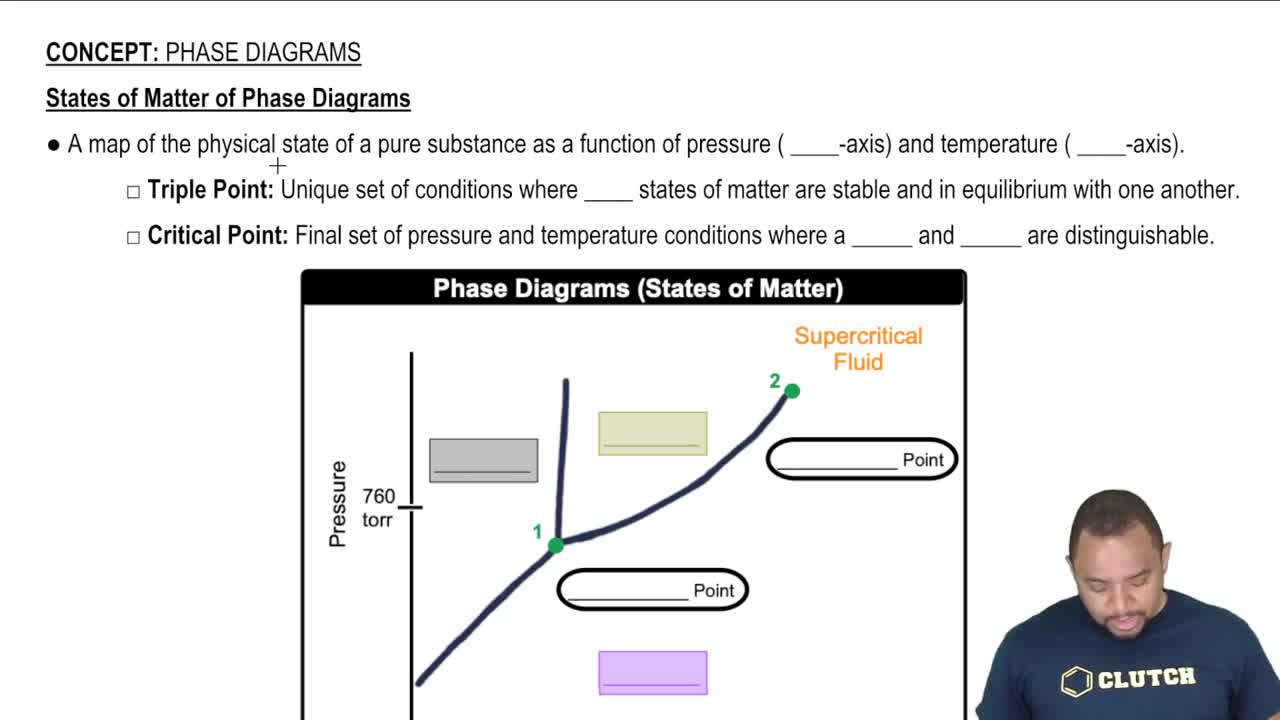
  • What is represented by point A on the phase diagram?
    Point A on a phase diagram typically represents the triple point, where solid, liquid, and gas phases coexist in equilibrium.
  • How are sublimation and deposition different from each other?
    Sublimation is the process where a solid changes directly to a gas, while deposition is the process where a gas changes directly to a solid.
  • Which is the process by which a gas changes to a solid?
    Deposition is the process by which a gas changes to a solid.
  • What is an example of sublimation?
    Dry ice (solid carbon dioxide) turning directly into carbon dioxide gas is an example of sublimation.
  • What is represented by point D on the phase diagram?
    Point D on a phase diagram typically represents the critical point, where the liquid and gas phases become indistinguishable.
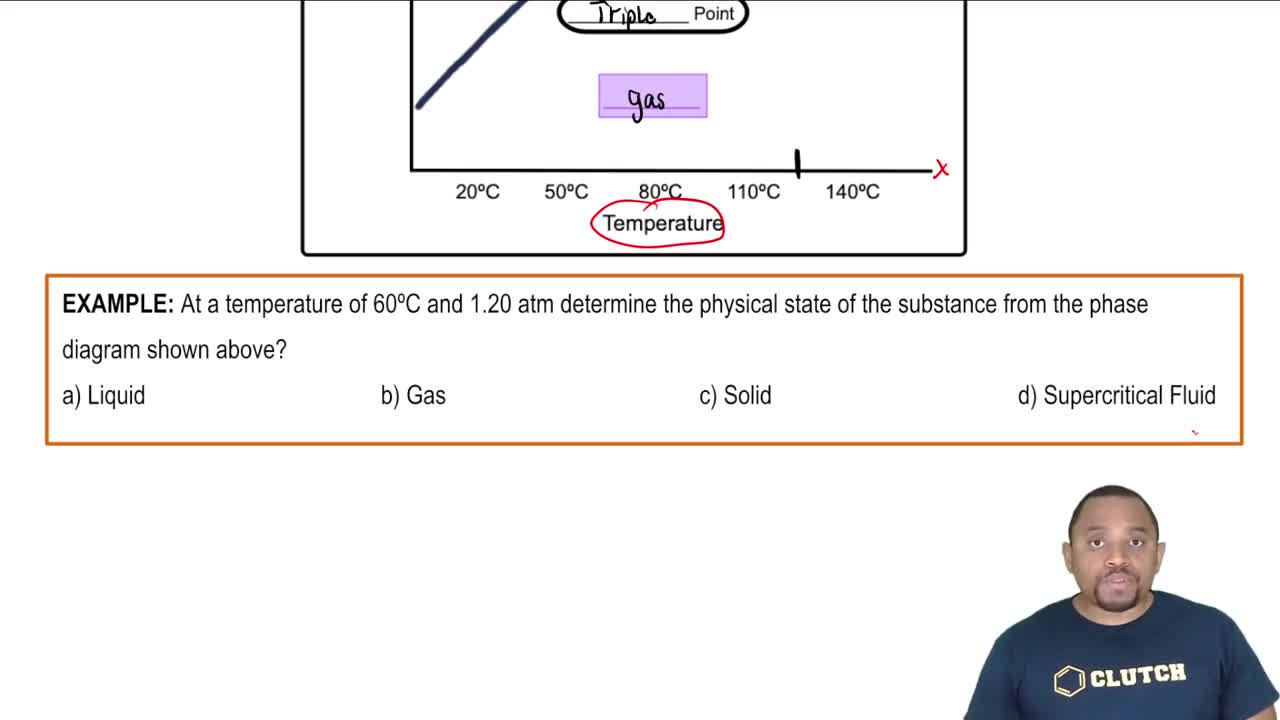
  • Which of the following phases does a sample of water exist in at its triple point?
    At the triple point, water exists simultaneously as solid, liquid, and gas in equilibrium.
  • When are propane molecules in a liquid state?
    Propane molecules are in a liquid state at temperatures and pressures between its melting and boiling points, as shown on its phase diagram.
  • What is the triple point?
    The triple point is the unique temperature and pressure at which all three phases (solid, liquid, and gas) of a substance coexist in equilibrium.
  • What happens when substances undergo changes of state?
    When substances undergo changes of state, their molecules rearrange and the intermolecular forces change, resulting in a transition between solid, liquid, and gas phases.
  • What occurs when a substance melts?
    When a substance melts, it changes from a solid to a liquid as heat breaks the intermolecular forces holding the solid together.
  • The average distance between molecules always increases during which of the following phase changes?
    The average distance between molecules always increases during melting, vaporization, and sublimation.
  • Which phase change occurs during sublimation?
    During sublimation, a solid changes directly into a gas.
  • In which region is the substance in both the solid phase and the liquid phase?
    The substance is in both the solid and liquid phase in the region along the melting (fusion) curve on the phase diagram.
  • Which of the following causes a substance to change its state of matter from a solid to a liquid?
    Increasing temperature (adding heat) causes a substance to change from solid to liquid.
  • What happens when water molecules change from solid to liquid?
    When water molecules change from solid to liquid, they gain energy and move more freely, breaking some of the hydrogen bonds.
  • What occurs when a gas is changed into a liquid?
    When a gas changes into a liquid, the process is called condensation, where molecules lose energy and come closer together.
  • What is the process that occurs when water vapor is cooled and changes from a gas to a liquid?
    Condensation is the process where water vapor cools and changes from a gas to a liquid.
  • Which of the following changes occurs as a solid is heated?
    As a solid is heated, it may melt and change into a liquid.
  • Which factors cause transitions between the liquid and gas state?
    Changes in temperature and pressure cause transitions between the liquid and gas state.
  • Which of the following is an example of deposition?
    Frost forming from water vapor is an example of deposition.
  • What phase change is known as deposition?
    Deposition is the phase change where a gas turns directly into a solid.
  • What is the triple point of water?
    The triple point of water is 0.01°C and 0.006 atm, where solid, liquid, and gas phases coexist.
  • What phase change is known as sublimation?
    Sublimation is the phase change where a solid turns directly into a gas.
  • What phase change is known as condensation?
    Condensation is the phase change where a gas turns into a liquid.
  • What happens during the phase change of condensation?
    During condensation, gas molecules lose energy and come closer together to form a liquid.
  • At what temperature does the solid start melting?
    The solid starts melting at its melting point, which can be found on the phase diagram at the intersection of the solid-liquid boundary at normal pressure.
  • What needs to happen for solid water to change to liquid water?
    Solid water (ice) must absorb heat to reach its melting point for it to change to liquid water.
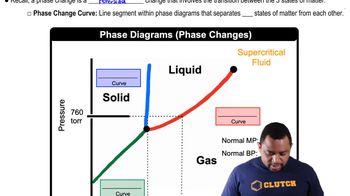
  • A phase change graph is shown below. What is the melting point of this substance?
    The melting point is the temperature at which the solid and liquid phases are in equilibrium, as indicated on the phase diagram at normal pressure.
  • In which process does a solid change directly into a vapor?
    Sublimation is the process where a solid changes directly into a vapor (gas).
  • Which number on the graph represents the phase change melting?
    The number on the graph at the intersection of the solid and liquid regions (fusion curve) represents the phase change melting.
  • What point has water reached when it turns from a liquid to a solid?
    Water has reached its freezing point when it turns from a liquid to a solid.
  • What occurs during condensation?
    During condensation, a gas loses energy and changes into a liquid.
  • What happens when water vapor is cooled?
    When water vapor is cooled, it condenses into liquid water.
  • Removing thermal energy from liquid water can cause it to change to what state?
    Removing thermal energy from liquid water can cause it to change to the solid state (ice).
  • Which of the following related to phase changes of water is incorrectly matched?
    An example of an incorrectly matched phase change is 'sublimation: liquid to gas' (correctly, sublimation is solid to gas).
  • When a substance changes from one phase to another, what is this process called?
    When a substance changes from one phase to another, the process is called a phase change.
  • Which statement describes ice and liquid water in a stoppered flask at 0°C at equilibrium?
    At 0°C in a stoppered flask, ice and liquid water are in equilibrium, meaning the rates of melting and freezing are equal.
  • Which two particle diagrams represent two different phases of the same compound?
    Particle diagrams showing different arrangements and spacing of the same molecules represent two different phases of the same compound (e.g., solid and liquid water).