Phase Diagrams quiz #2 Flashcards

Phase Diagrams quiz #2
Control buttons has been changed to "navigation" mode.
1/10
  • What happens when water vapor cools?
    When water vapor cools, it condenses into liquid water.
  • Label the features of the phase diagram.
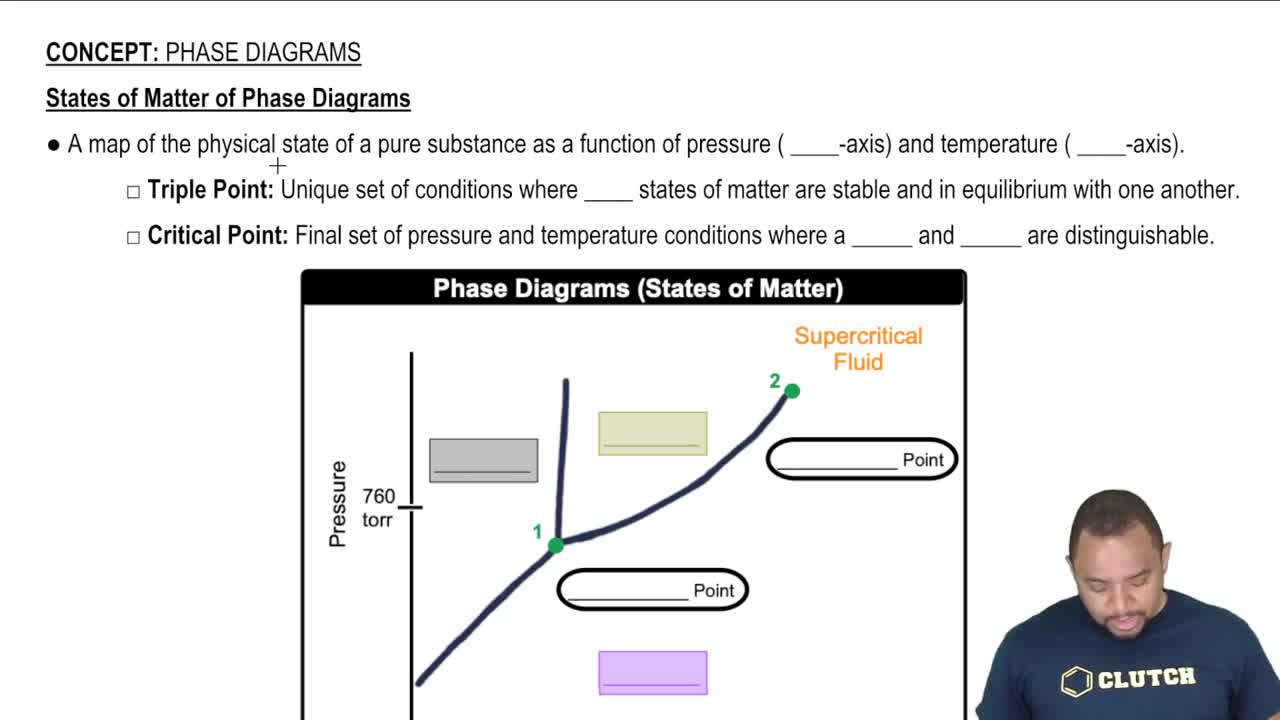
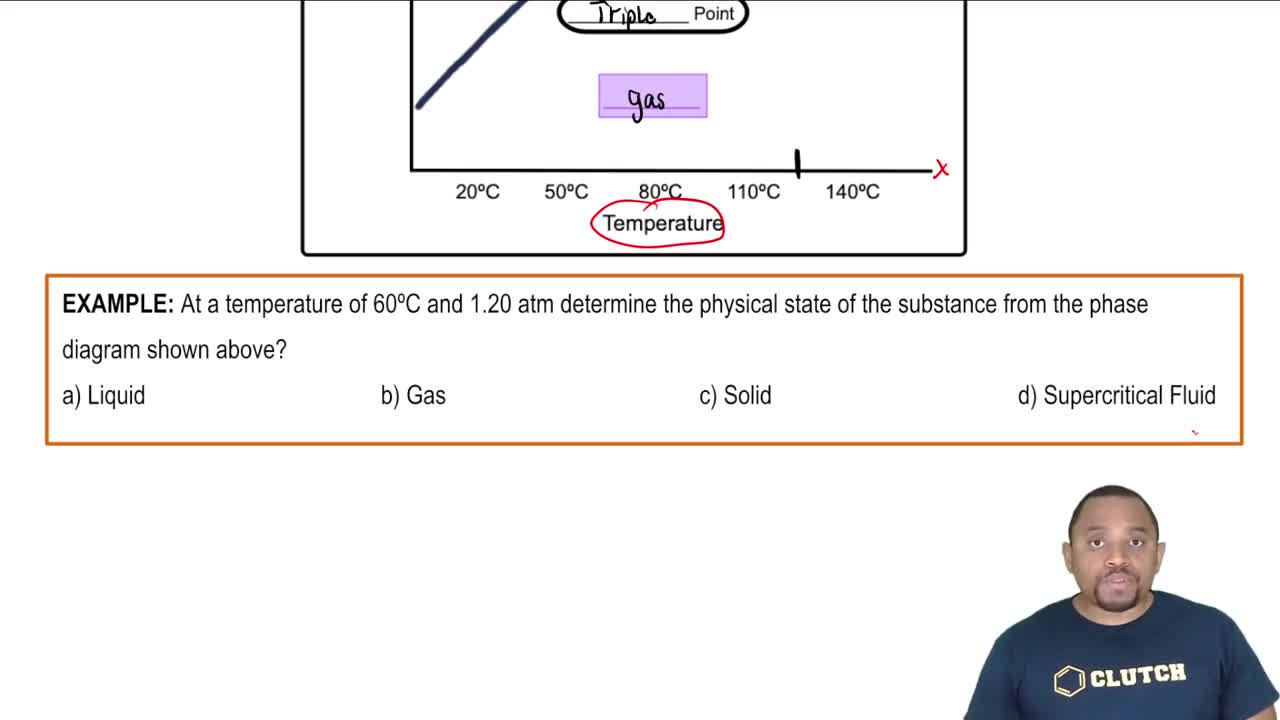
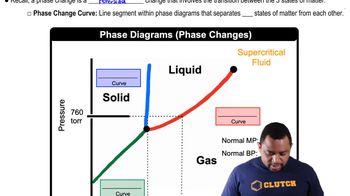
    The phase diagram features include the solid, liquid, and gas regions, the triple point, the critical point, and the phase boundaries (fusion, vaporization, and sublimation curves).
  • Consider the phase diagram for carbon dioxide.
    The phase diagram for carbon dioxide shows its solid, liquid, and gas regions, with a triple point and critical point; CO2 sublimates at atmospheric pressure because its triple point is above 1 atm.
  • What does the y-axis and x-axis represent on a typical phase diagram?
    The y-axis represents pressure and the x-axis represents temperature on a phase diagram.
  • What is a supercritical fluid and where does it occur on a phase diagram?
    A supercritical fluid occurs beyond the critical point, where the substance is neither a true liquid nor a true gas.
  • What is the term for the phase change from solid directly to gas?
    The phase change from solid directly to gas is called sublimation.
  • How is the normal melting point identified on a phase diagram?
    The normal melting point is found at the intersection of the fusion curve and the line for normal pressure (1 atm).
  • What is the significance of the fusion curve on a phase diagram?
    The fusion curve separates the solid and liquid regions and represents the conditions under which melting or freezing occurs.
  • How can you determine the normal boiling point from a phase diagram?
    The normal boiling point is where the vaporization curve intersects the line for normal pressure (1 atm).
  • What is meant by 'normal pressure' in the context of phase diagrams?
    Normal pressure refers to the standard pressure of 1 atmosphere, which is equivalent to 760 torr or 760 mmHg.