Quantum Numbers: Magnetic Quantum Number quiz #1 Flashcards

Quantum Numbers: Magnetic Quantum Number quiz #1
Control buttons has been changed to "navigation" mode.
1/16
  • What is the only possible value of the magnetic quantum number (ml) for an electron in an s orbital?
    The only possible value of ml for an electron in an s orbital is 0.
  • Which is a correct set of values for the magnetic quantum number (ml) for one of the subshells when n = 2?
    For n = 2, the possible subshells are l = 0 (s) and l = 1 (p). For l = 1, ml can be -1, 0, or +1.
  • What are the possible values of the magnetic quantum number (ml) for each of the following values of the angular momentum quantum number (l)?
    For l = 0: ml = 0; for l = 1: ml = -1, 0, +1; for l = 2: ml = -2, -1, 0, +1, +2; for l = 3: ml = -3, -2, -1, 0, +1, +2, +3.
  • How many values of the magnetic quantum number (ml) are allowed for an electron in a 2s subshell?
    For a 2s subshell (l = 0), only one value of ml is allowed: 0.
  • What are the allowed values for the magnetic quantum number (ml)?
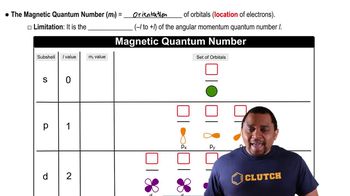
    The allowed values for ml are all integers from -l to +l, where l is the angular momentum quantum number.
  • How many degenerate orbitals can be found in each p subshell?
    Each p subshell has 3 degenerate orbitals, corresponding to ml values of -1, 0, and +1.
  • What does the magnetic quantum number (ml) determine?
    The magnetic quantum number determines the orientation and specific orbital location of an electron within a subshell.
  • How many different values of the magnetic quantum number (ml) are possible in the 2p sublevel?
    In the 2p sublevel (l = 1), there are 3 possible values for ml: -1, 0, and +1.
  • How many orbitals can have quantum numbers of n = 3 and ml = -1?
    For n = 3 and ml = -1, there are three possible subshells (l = 0, 1, 2), but only l = 1 (p) and l = 2 (d) allow ml = -1, so two orbitals can have these quantum numbers.
  • How many values of the magnetic quantum number (ml) are allowed for an electron in a 5f subshell?
    For a 5f subshell (l = 3), there are 7 allowed values for ml: -3, -2, -1, 0, +1, +2, +3.
  • What are the possible values of the magnetic quantum number (ml)?
    The possible values of ml are all integers from -l to +l, where l is the angular momentum quantum number.
  • How many different values of the magnetic quantum number (ml) are possible in the 5d sublevel?
    In the 5d sublevel (l = 2), there are 5 possible values for ml: -2, -1, 0, +1, and +2.
  • What is the maximum number of electrons that can occupy one p orbital?
    The maximum number of electrons that can occupy one p orbital is 2.
  • What is the maximum number of electrons that can occupy one p orbital?
    The maximum number of electrons that can occupy one p orbital is 2.
  • What is the maximum number of electrons that can occupy one p orbital?
    The maximum number of electrons that can occupy one p orbital is 2.
  • List all possible values of the magnetic quantum number (ml) for an electron in a given subshell.
    All possible values of ml for a given subshell are the integers from -l to +l, where l is the angular momentum quantum number.