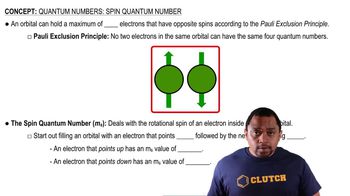
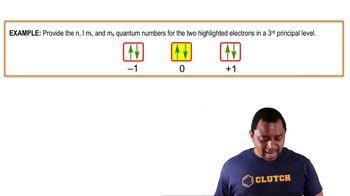
What is the spin quantum number (ms) of a 3s2 electron in phosphorus?
The spin quantum number (ms) of a 3s2 electron in phosphorus can be either +1/2 or -1/2, depending on whether it is the first or second electron in the orbital.
How many electrons in the 3d subshell can have a spin quantum number of +1/2?
A maximum of 5 electrons in the 3d subshell can have a spin quantum number of +1/2, as each of the 5 orbitals can hold one electron with +1/2 spin.
What does the Pauli exclusion principle state?
The Pauli exclusion principle states that no two electrons in the same orbital can have the same set of four quantum numbers.
What is the maximum number of electrons that can occupy one p orbital?
The maximum number of electrons that can occupy one p orbital is 2, with opposite spins.
What relationship do the spins of electrons sharing the same orbital have with each other?
Electrons sharing the same orbital must have opposite spins, one with +1/2 and one with -1/2.
Can an electron have the same set of quantum numbers as another electron in the same orbital?
No, an electron cannot have the same set of quantum numbers as another electron in the same orbital, according to the Pauli exclusion principle.
What does the spin quantum number (ms) represent in an atomic orbital?
The spin quantum number (ms) represents the rotational spin direction of an electron within an atomic orbital, either up (+1/2) or down (-1/2).
How are the spins of electrons assigned when filling an orbital?
The first electron in an orbital is assigned an upward spin (+1/2), and the second is assigned a downward spin (-1/2).
Why must electrons in the same orbital have opposite spins?
Electrons in the same orbital must have opposite spins to ensure they have unique sets of quantum numbers, as required by the Pauli exclusion principle.
What is the maximum number of electrons that can occupy a single orbital, and why?
A single orbital can hold a maximum of two electrons because each must have a different spin quantum number.