Rate of Radioactive Decay definitions Flashcards
Rate of Radioactive Decay definitions
You can tap to flip the card.
Control buttons has been changed to "navigation" mode.
1/15
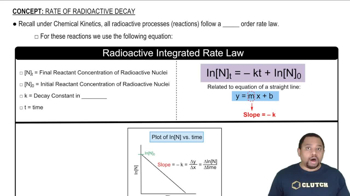
Radioactive decayA process following a first-order rate law, characterized by a decrease in radioactive nuclei over time.First-order rate lawA kinetic model where the rate of reaction is directly proportional to the concentration of one reactant.Decay constantA proportionality factor in the radioactive decay equation, indicating the rate of decay over time.Natural logThe logarithm to the base e, used in the integrated rate law to express concentration changes.Integrated rate lawAn equation relating the concentration of reactants to time, used to describe radioactive decay.ConcentrationThe amount of a substance in a given volume, which in radioactive decay can refer to disintegrations per second.SlopeIn the context of decay, it represents the negative decay constant in a plot of ln(N) versus time.TimeA variable in the decay equation, representing the duration over which decay is measured.Disintegrations per secondA unit of measure for radioactive decay, indicating the number of nuclei decaying each second.Straight line equationA mathematical representation, y=mx+b, used to describe the linear relationship in decay plots.GraphA visual representation of data, such as ln(N) versus time, showing the decay process.Y-axisThe vertical axis in a graph, representing ln(N) in the context of radioactive decay.X-axisThe horizontal axis in a graph, representing time in the context of radioactive decay.Initial concentrationThe starting amount of radioactive nuclei before decay begins, denoted as N0.Final concentrationThe remaining amount of radioactive nuclei after a period of decay, denoted as N.