Skip to main content
General Chemistry
My Course
Learn
Exam Prep
AI Tutor
Study Guides
Textbook Solutions
Flashcards
Explore
Try the app
My Course
Learn
Exam Prep
AI Tutor
Study Guides
Textbook Solutions
Flashcards
Explore
Try the app
Back
Solutions: Mass Percent quiz
You can tap to flip the card.
What is the formula for calculating mass percent in a solution?
You can tap to flip the card.
👆
What is the formula for calculating mass percent in a solution?
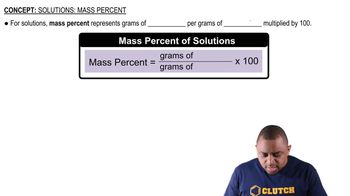
Mass percent = (grams of solute / grams of solution) × 100.
Track progress
Control buttons has been changed to "navigation" mode.
1/15
Related flashcards
Related practice
Recommended videos
Solutions: Mass Percent definitions
Solutions: Mass Percent
10 Terms
Solutions: Mass Percent
14. Solutions
3 problems
Topic
Jules
Types of Aqueous Solutions
14. Solutions
5 problems
Topic
Jules
14. Solutions - Part 1 of 3
4 topics
12 problems
Chapter
Jules
14. Solutions - Part 2 of 3
5 topics
12 problems
Chapter
Jules
14. Solutions - Part 3 of 3
5 topics
12 problems
Chapter
Jules
Guided course
02:30
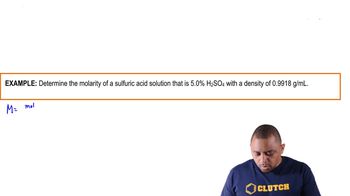
Molarity Calculation Example
2750
views
16
rank
1
comments
Guided course
00:51
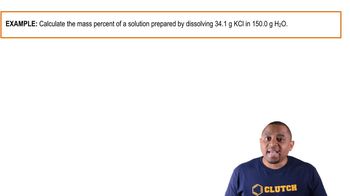
Mass Percent Calculation Example
2977
views
27
rank
Guided course
00:24
Solutions: Mass Percent
3703
views
25
rank
Terms in this set (15)
Hide definitions
What is the formula for calculating mass percent in a solution?
Mass percent = (grams of solute / grams of solution) × 100.
How do you interpret a 2.50% sodium hydroxide solution in terms of grams?
It means there are 2.50 grams of sodium hydroxide in every 100 grams of the solution.
What does the denominator represent in the mass percent formula?
The denominator represents the total mass of the solution.
How can mass percent be used as a conversion factor?
Mass percent can be used to convert between grams of solute and grams of solution.
What is the reciprocal form of the mass percent conversion factor for a 2.50% NaOH solution?
It is 100 grams of solution over 2.50 grams of NaOH.
Why is mass percent important in chemical formulation?
It quantifies the ratio of solute to solution, ensuring precise chemical reactions.
What does the numerator in the mass percent formula represent?
The numerator represents the mass of the solute.
How would you express mass percent as a ratio for calculations?
You can write it as grams of solute per 100 grams of solution.
What unit is mass percent typically expressed in?
Mass percent is expressed as a percentage (%).
How does mass percent help in converting to molarity?
It provides a conversion factor to relate grams of solute to the total solution mass, aiding in molarity calculations.
If you have 5 grams of solute in 200 grams of solution, what is the mass percent?
The mass percent is (5/200) × 100 = 2.5%.
What does a mass percent value tell you about a solution?
It tells you how many grams of solute are present in 100 grams of the solution.
Can mass percent be used for any solute in a solution?
Yes, mass percent can be calculated for any solute in a solution.
What is the significance of multiplying by 100 in the mass percent formula?
Multiplying by 100 converts the ratio into a percentage.
How would you use mass percent to find the mass of solute in a given mass of solution?
Multiply the mass percent (as a decimal) by the total mass of the solution.
 BackBack
 02:30
02:30