Solutions: Solubility and Intermolecular Forces definitions Flashcards
Solutions: Solubility and Intermolecular Forces definitions
You can tap to flip the card.
Control buttons has been changed to "navigation" mode.
1/15
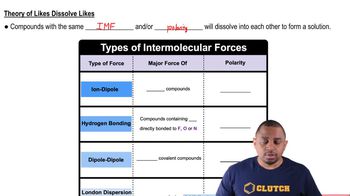
SolubilityA chemical property indicating a solute's ability to dissolve in a solvent, forming a homogeneous mixture.MiscibleDescribes two substances that can mix to form a homogeneous mixture or solution.Homogeneous mixtureA mixture where the components are uniformly distributed, also known as a solution.Heterogeneous mixtureA mixture where the components are not uniformly distributed, indicating a solute is not dissolved.Intermolecular forcesForces that mediate interaction between molecules, affecting solubility and miscibility.Ion-dipoleThe strongest intermolecular force, occurring between ionic compounds and polar molecules.Hydrogen bondingA strong type of dipole-dipole interaction occurring when hydrogen is bonded to fluorine, oxygen, or nitrogen.Dipole-dipoleAn intermolecular force between polar covalent molecules, where positive and negative ends attract.London dispersion forcesWeak intermolecular forces present in all molecules, dominant in nonpolar covalent compounds.PolarityA property of molecules with uneven distribution of charges, affecting solubility and miscibility.SolutionA homogeneous mixture formed when a solute is dissolved by a solvent.Ionic compoundsCompounds composed of ions held together by electrostatic forces, often exhibiting ion-dipole interactions.Polar covalent compoundsCompounds with polar bonds due to unequal sharing of electrons, exhibiting dipole-dipole forces.Nonpolar covalent compoundsCompounds with equal sharing of electrons, primarily exhibiting London dispersion forces.Like dissolves likeA principle stating that substances with similar polarities or intermolecular forces are likely to be miscible.