Back

Solutions: Solubility and Intermolecular Forces quiz

Control buttons has been changed to "navigation" mode.
1/15
  • What is solubility in chemistry?

    Solubility is a chemical property describing a solute's ability to dissolve in a solvent to form a homogeneous mixture.
  • What is a homogeneous mixture?

    A homogeneous mixture is a solution where the solute and solvent are evenly mixed, forming a single phase.
  • What is a heterogeneous mixture?

    A heterogeneous mixture occurs when a solute does not dissolve in a solvent, resulting in distinct phases.
  • What does the phrase 'like dissolves like' mean?

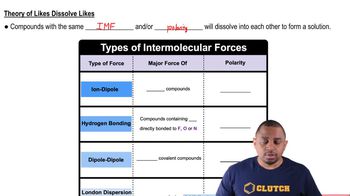
    'Like dissolves like' means that substances with similar intermolecular forces or polarities are likely to dissolve in each other.
  • What is meant by the term 'miscible'?

    Miscible means that two substances can mix together to form a homogeneous solution.
  • Which intermolecular force is the strongest?

    Ion-dipole forces are the strongest intermolecular forces.
  • In what type of compounds are ion-dipole forces the major force?

    Ion-dipole forces are the major force in ionic compounds.
  • What is required for hydrogen bonding to occur?

    Hydrogen bonding occurs when hydrogen is directly bonded to fluorine, oxygen, or nitrogen.
  • Are hydrogen bonds considered polar or nonpolar intermolecular forces?

    Hydrogen bonds are considered polar intermolecular forces.
  • What is the major intermolecular force in polar covalent compounds?

    Dipole-dipole forces are the major intermolecular force in polar covalent compounds.
  • What are London dispersion forces also known as?

    London dispersion forces are also called Van der Waals forces or simply dispersion forces.
  • Which type of compounds have London dispersion forces as their only major force?

    Nonpolar covalent compounds have London dispersion forces as their only major force.
  • Do all compounds have London dispersion forces?

    Yes, all compounds have London dispersion forces, but they are dominant only in nonpolar compounds.
  • What happens if you mix a polar and a nonpolar substance?

    A polar and a nonpolar substance will not mix and will not form a solution.
  • How can you predict if two substances are miscible if you can't tell their polarity?

    If you can't tell their polarity, compare their intermolecular forces; if both have the same type, they are likely miscible.